Understanding Climate Change: Causes, Effects, and Personal Actions
110 likes | 227 Vues
Climate change refers to long-term alterations in weather patterns, largely driven by human activities. It manifests in various forms, including global warming, which denotes a rise in average global temperatures. The leading causes include greenhouse gases like CO2, methane, and nitrous oxide, resulting in a thickening atmospheric blanket. Individuals can make a difference by being informed, assessing their carbon footprints, and making eco-friendly choices in transportation, energy use, and food consumption. Each person's effort contributes to addressing this critical global issue.


Understanding Climate Change: Causes, Effects, and Personal Actions
E N D
Presentation Transcript
Climate Change What do you know? and what are you going to do about it?
Climate Change? • What do you know about it? • What are the causes? • What are greenhouse gases? • What are C02 equivalents? • What can you do to make a difference?
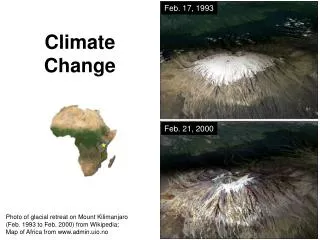
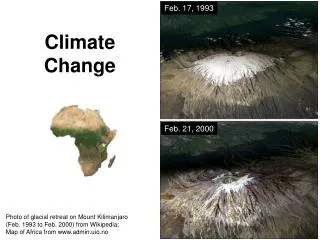
What is Climate Change? In a nutshell, climate change occurs when long-term weather patterns are altered — for example, through human activity. Global warming is one measure of climate change, and is a rise in the average global temperature. davidsuzuki.org
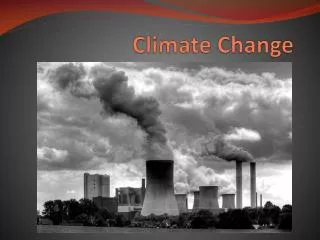
Causes of Climate Change? • Our atmosphere is like a blanket • Adding greenhouse gases makes the blanket thicker • Human Activity • ~32% increase in CO2 since 1900 • Methane - CH4(25x), Nitrous Oxide - N2O (300x), +… • We can consider the overall effect by considering CO2e • Natural Causes and Variation • “Levels of methane and carbon dioxide are the highest they have been in nearly half a million years.”
What can you do? • Become informed • Examine how you contribute to climate change • Can you reduce your carbon footprint?
Transportation • Typical car contributes ~5 T of CO2equivalents/year • What portion of that are you responsible for – through your choices?
Shower • L/min shower, input temp, output temp? • 0.00116 kW-h of electricity to heat 1 L of water 1°C • Estimate 1kW-h in Canada is 0.2 kg of CO2e • Similar to natural gas emissions for the same amount • Recovery of energy (heat)?
Electronics • Game systems • Computer systems • TV systems • Range from 100-400 watts in use, 1-20 watts standby • Estimate 1kW-h in Canada is 0.2 kg of CO2e
Food • The food system is responsible for 1/3 of global greenhouse emissions and about 60% of that is linked to meat production – How? • High impact foods • (beef, lamb, shrimp, farmed salmon cheese, tofu?) • Medium impact foods? • (pork, chicken, imported fish, eggs, butter, imported/hh fruits and vegetables) • Low impact foods? • (local fruits and vegetables, wild fish, grains, beans, margarine, milk?)
Reference points • Canada produces ~600 000 000 t of CO2e/year (1990) • ~20 t per person (significant portion is industry) • ~5-10 t per person for home and lifestyle choices