
Intersection of Three Planes: Finding Points and Vector Equations
This documentation explains the process of finding the point at which three planes intersect, utilizing the equations of planes provided in Example 35. When given specific values for λ and μ, one can determine the point of intersection using Gaussian elimination. The document also explores the vector equation of the line formed by the intersection of two planes and investigates conditions under which no common intersection exists. Additionally, it details the Cartesian equation of the plane that contains the line and a given point.

Intersection of Three Planes: Finding Points and Vector Equations
E N D
Presentation Transcript
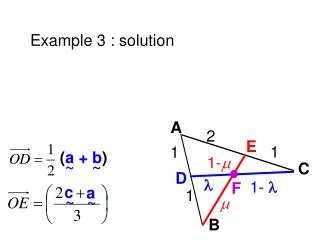
c a ~ ~ (a + b) ~ ~ Example 3 : solution A 2 E 1 1 1- C D 1- F 1 B
c a b a c b a c ~ ~ ~ ~ ~ ~ ~ ~ A (a + b) 2 ~ ~ Since a, b and care non-parallel vectors, E 1 1 ~ ~ ~ 1- C D 1- F 1 B ~ ~ ~
Example 35:The eqn of 3 planes p1, p2, p3 are 2x 5y + 3z = 3, 3x + 2y 5z = 5, 5x + y + 17z = . When = 20.9 and = 16.6, find the pt at which planes meet. Soln When = 20.9 and = 16.6, We have eqns: 2x 5y + 3z = 3, 3x + 2y 5z = 5, 5x 20.9y + 17z = 16.6 Using GC Plysmlt2, x = - 4/11, y = - 4/11, z = 7/11 Hence, pt of intersection is
Example 35 (con’t): The planes p1 and p2 intersect in a line l. (i) Find a vector eqn of l. Soln (i) p1: 2x 5y + 3z = 3, p2 : 3z + 2y 5z = 5 Using GC Plysmlt2,
Example 35 (con’t):(ii) Given that all 3 planes meet in the line l, find and. Soln(ii) Given p3: 5x + y + 17z = So l must lie on p3. So normal of p3 is l, i.e. 5 + + 17 = 0 = - 22 = 17
Example 35 (con’t): (iii) Given instead that the 3 planes hv no point in common, what can be said about and? Soln (iii) If there is no pt in common. Since p1 and p2 intersect at l. Hence, l can be parallel to p3, so can be - 22 But l should not lie on p3,so cannot be 17.
Example 35 (con’t): (iv) Find the cartesian eqn of the plane which contains l and the point (1, 1, 3). Soln l Cartesian eqn: 3x – y – 2z = –2
