PARTICIPATORY BUDGETING
150 likes | 278 Vues
Participatory Budgeting (PB) empowers communities to decide how public budgets are allocated, engaging local residents in discussions, proposals, and decision-making. Originating in Porto Alegre, Brazil, in the 1980s, PB is now implemented in over 300 cities worldwide, recognized for enhancing local ownership, transparency, social cohesion, and cost-effectiveness in public services. While PB may only involve a small portion of public budgets, its principles promote stronger democratic engagement. Learn about its models and explore the potential benefits and challenges of adopting PB in various contexts.


PARTICIPATORY BUDGETING
E N D
Presentation Transcript
PARTICIPATORY BUDGETING INTRODUCTION AND OVERVIEW Alan Budge PB Unit.
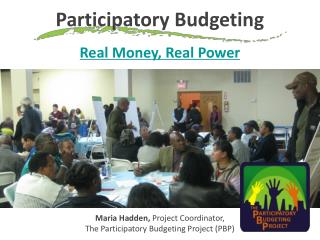
DEFINING PARTICIPATORY BUDGETING • Participatory Budgeting directly involves local people in making decisions on the spending and priorities for a defined public budget. This means engaging residents and community groups to discuss spending priorities, make spending proposals, and vote on them, as well as giving local people a role in the scrutiny and monitoring of the process’ • CLG National PB Strategy (Sept 2008)
OR • ‘Local people decide how to allocate part of a public budget’ Participatory Budgeting Unit Values Principles and Standards ‘If it feels like we have decided ---- it’s PB. If it feels like someone else has decided, it isn’t.’ Brazilian resident involved in PB
HEALTH WARNING! Only a small percentage of any public budget will be allocated using PB The PB process is formally mandated and ‘signed off’ by the elected legislature
ORIGINS OF PARTICIPATORY BUDGETING Began in Porto Alegre, Brazil in 1980s – city of 1.5m people End of military dictatorship and election of Workers’ Party
DEVELOPMENT OF PB Now in 300+ cities worldwide, including Latin America, Canada, USA and over 25 in Europe Identified as good practise by international institutions, including World Bank, UNESCO, OECD, UN Habitat prize, and DFID 100 + authorities in UK now developing pilots Links with Con/Lib ‘Big Society’ agenda
Possible PB Models 1. Small grants allocation 2. Small scale mainstream allocation 3. Mainstream Investment
Project Design Evaluation and Learning The PB cycle Informing and engaging Scrutiny and Monitoring Setting of Priorities Delivery of new projects Decision Making Develop budget Ideas
Potential Benefits of PB • Engages more people and different people • Better targeted and cost-effective services. (Evidence that PB ‘Closes the gap’) • Consultation/engagement/involvement are inevitable ‘by products’ of a PB process • Strong social cohesion benefits • Local ownership of projects, budgets, decisions
More potential benefits of PB • More mature debate about priorities –reshaping relationship between elected members, officers and residents • Potential for higher tax-raising / voting / approval? • Develops budget literacy • Greater transparency re public finances
PB - issues to consider How does PB fit with existing democratic structures? Is/should PB be representative? Is the expense justified? Will PB raise unrealistic or unmanageable expectations?
The participatory budget in Brazil. The left column reads, “where the money comes from.” The one on the right reads, “what the money is spent for.” Below it says, “When the administration is transparent, everything works smoothly
Our website www.participatorybudgeting.org.uk