Washington Jeopardy: Explore State History in a Fun Game!
Join a fun and educational game exploring Washington State's history through a Jeopardy-style competition. Answer questions about important events, figures, and laws to earn points and emerge as the ultimate champion. Test your knowledge and learn fascinating facts about Washington's past.
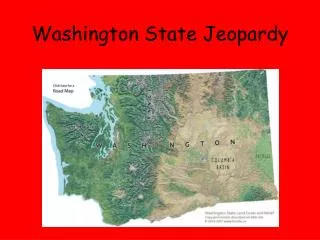

Washington Jeopardy: Explore State History in a Fun Game!
E N D
Presentation Transcript
Rules • Answers MUST be in the form of a question • Team with the highest point total selects the question • Teams MUST raise their hands to answer a question • The team with the most points at the end of the game wins • If you don’t know an answer, check the book
Statehood for 100 • In order to become a state, Washington needed a population of people. • 60,000
Statehood for 200 • Washington granted women in 1910, a decade before the 19th amendment was passed. • Suffrage
Statehood for 300 • This man served as the first territorial governor of Washington. • Isaac Stevens
Statehood for 400 • A tax system in which people pay a higher percentage of their income as taxes the more they make is known as a income tax. • graduated
Statehood for 500 • Hiram Gill, the mayor of Seattle, was removed from office for corruption in the early 1900s by the use of a process known as . • recall
Native Americans for 100 • Native American Children were often sent to these in order to be taught how to assimilate into white society. • Indian Boarding Schools
Native Americans for 200 • The were a series of 14 documents which established many of the Native American Reservations in Washington. • Stevens Treaties
Native Americans for 300 • The Nez Perce and Yakama Wars started because white settlers trespassed onto Native Reservations searching for . • Gold
Native Americans for 400 • This Nez Perce leader famously said that he “would fight no more, forever” after he was surrounded by the U.S. Army just south of the Canadian border. • Chief Joseph
Native Americans for 500 • The act of intentionally killing a group of people with the intent to exterminate them is known as . • Genocide
The Gilded Age/Progressive Erafor 100 • When a single individual or company has total control of an industry, it is known as having a . • Monopoly
The Gilded Age/Progressive Erafor 200 • The 18th Amendment attempted to solve many societal problems by banning the production and sale of this product. • Alcohol
The Gilded Age/Progressive Erafor 300 • List the three main things that workers unionized to improve. • Better pay, shorter hours, safer working conditions
The Gilded Age/Progressive Erafor 400 • The IWW was a union which accepted all workers and earned a poor reputation for being willing to sabotage property. They were commonly known as the . • Wobblies
The Gilded Age/Progressive Erafor 500 • A universal fire safety code was implemented after a disastrous fire at the . • Triangle Shirtwaist Factory
Depression/WWII for 100 • Plutonium for the atom bomb was refined at this location in Eastern Washington • Hanford
Depression/WWII for 200 • Named for the depression-era president, these shanty towns popped up all over the United States during the 1930s. • Hoovervilles
WWII for 300 • The forced relocation of Japanese Americans to camps across the western United States was known as . • Internment
Depression/WWII for 400 • The program designed by FDR to get Americans back to work following the Great Depression was collectively known as . • The New Deal
WWII for 500 • This document authorized the internment of 120,000 Japanese American Citizens in violation of their 14th and 5th Amendment rights. • Executive Order 9066
Grab Bag for 100 • This Washington company produced B-17 and B-29 bombers to combat Germany and Japan. • Boeing
Grab Bag for 200 • Voters can propose a law directly to a ballot by this process. • Initiative
Grab Bag for 300 • This system allowed politicians to use their power and influence in order to secure votes. • The Spoils System
Grab Bag for 400 • This law allowed for the creation of Native American Boarding Schools and allowed Natives to become citizens if they gave up all ties to their tribe. • The Dawes Act
Grab Bag for 500 • Dorthea Lange was a photojournalist who captured images of this event, in which thousands of people headed west due to extreme weather hazards. • The Dust Bowl
Final Jeopardy • This individual filed a lawsuit against the United States, arguing that Japanese Internment was unconstitutional. • Fred Korematsu