Advancements in Future Circular Colliders: Contributions from Swiss Accelerator Community
10 likes | 129 Vues
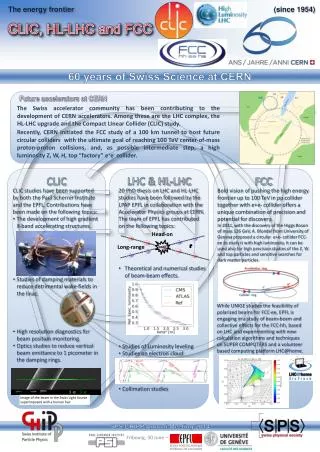
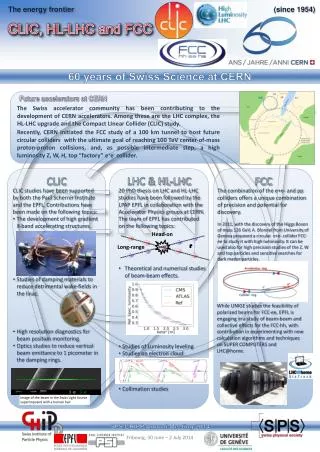
The Swiss accelerator community plays a pivotal role in the development of CERN's advanced accelerators, including the LHC complex, HL-LHC upgrade, and CLIC study. Recently, CERN initiated the FCC study for a 100 km tunnel aimed at future circular colliders, targeting 100 TeV proton-proton collisions and a high luminosity electron-positron collider for precision studies. Collaborations with institutions like EPFL and the Paul Scherrer Institute have led to significant innovations in accelerator technology, highlighting the potential for discoveries in particle physics, including dark matter.


Advancements in Future Circular Colliders: Contributions from Swiss Accelerator Community
E N D
Presentation Transcript
The energy frontier • The Swiss accelerator community has been contributing to the development of CERN accelerators. Among these are the LHC complex, the HL-LHC upgrade and the Compact LInear Collider (CLIC) study. • Recently, CERN initiated the FCC study of a 100 km tunnel to host future circular colliders with the ultimate goal of reaching 100 TeV center-of-mass proton-proton collisions, and, as possible intermediate step, a high luminosity Z, W, H, top “factory” e+e- collider. • (since 1954) CLIC, HL-LHC and FCC r Future accelerators at CERN CLIC LHC & HL-LHC FCC • CLIC studies have been supported by both the Paul Scherrer Institute and the EPFL. Contributions have been made on the following topics: • The development of high gradient X-band accelerating structures. • Studies of damping materials to reduce detrimental wake-fields in the linac. • High resolution diagnostics for beam position monitoring. • Optics studies to reduce vertical beam emittance to 1 picometer in the damping rings. • 20 PhD thesis on LHC and HL-LHC studies have been followed by the LPAP EPFL in collaboration with the Accelerator Physics groups at CERN. The team of EPFL has contributed on the following topics: • Theoretical and numerical studies of beam-beam effects. • Studies of Luminosity leveling • Studies on electron cloud • Collimation studies The combination of the e+e- and pp collidersoffersa unique combination of precision and potential for discovery. In 2011, withthe discovery of the Higgs Boson of mass 126 GeV, A. Blondel fromUniversity of Geneva proposed a circulare+e- colliderFCC-ee to studyitwith high luminosity. It canbeusedalso for high precisionstudies of the Z, W and top particlesand sensitive searches for darkmatterparticles. Head-on Long-range • While UNIGE studies the feasibility of polarized beams for FCC-ee, EPFL is engaging in a study of beam-beam and collective effects for the FCC-hh, with • contribution in experimenting with new calculation algorithms and techniques on SUPER COMPUTERS and LHC@home. Image of the beam in the Swiss Light Source superimposed with a human hair