Download
1 / 11
110 likes | 264 Vues
This document explores various trigonometric expressions and equations, focusing on simplification techniques, addition and subtraction formulas, and DeMoivre's Theorem. It consists of multiple parts, including finding exact trigonometric values, expressing sums as products, and determining the additional force for equilibrium in physics problems. The goal is to refine mathematical skills related to trigonometry and vector forces. Each section includes multiple-choice questions to test understanding and application of these concepts effectively.

E N D
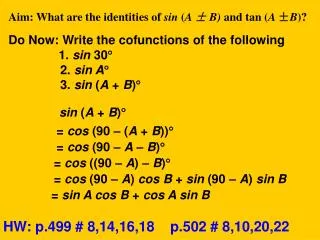
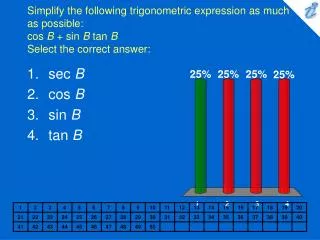
Simplify the following trigonometric expression as much as possible: cos B + sin B tan BSelect the correct answer: • sec B • cos B • sin B • tan B
1. 2. 3. Use an addition or subtraction formula to find the exact value of the expression: {image} Select the correct answer: • {image} • {image} • {image}
1. 2. 3. 4. Use an addition or subtraction formula to write the expression as a trigonometric function of one number: {image} . Select the correct answer: • {image} • {image} • {image} • {image}
1. 2. 3. Find sin 2x, cos 2x, and tan 2x from the given information: {image} Select the correct answer: • {image} • {image} • {image}
1. 2. 3. Write the following sum as a product: {image} Select the correct answer: • {image} • {image} • {image}
1. 2. 3. 4. Find all solutions of the following equation: {image} Select the correct answer, where k is any integer: • {image} • {image} • {image} • {image}
1. 2. 3. 4. Use an addition or subtraction formula to simplify the following equation. Then find all the solutions in the interval {image} sin 4 x cos 3 x - cos 4 x sin 3 x = 0 Select the correct answer: • {image} • {image} • {image} • {image}
Find the indicated power using DeMoivre’s Theorem. ( 1 - i ) 24 Select the correct answer: • 4,096 • -4,096 • -4,096 i
1. 2. 3. 4. u = i + j, v = i - j, find 7 u - 2 v. Choose the correct answer from the following : • {image} • {image} • {image} • {image}
The forces F1, F2, ..., Fn acting at the same point P are said to be in equilibrium if the resultant force is zero, that is, if F1 + F2 + ... + Fn = 0. F1 = i + j, F2 = i - j, F3 = 4 i + 8 jFind the additional force required for the forces to be in equilibrium P. Choose the correct answer from the following : • F4 = -6i - 8j • F4 = -6i + 8j • F4 = 6i + 8j • F4 = 8i - 6j
Find the component of u along v. u = 10 i - 14 j , v = 2 j. Select the correct answer: • -7 • 7 • -14 • 14