On-Demand Delivery Software_ Features, Pricing & Use Cases
0 likes | 0 Vues
Consumer expectations have shifted dramatically. A growing number of U.S. shoppers now expect faster delivery options, including same-day delivery service and next-day too.


On-Demand Delivery Software_ Features, Pricing & Use Cases
E N D
Presentation Transcript
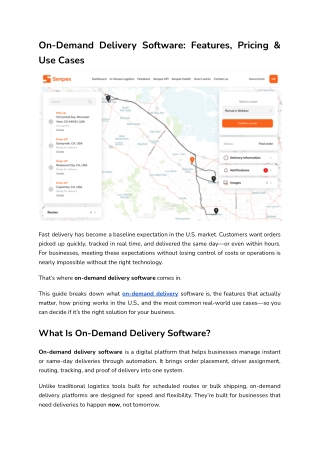
On-Demand Delivery Software: Features, Pricing & Use Cases Fast delivery has become a baseline expectation in the U.S. market. Customers want orders picked up quickly, tracked in real time, and delivered the same day—or even within hours. For businesses, meeting these expectations without losing control of costs or operations is nearly impossible without the right technology. That’s where on-demand delivery software comes in. This guide breaks down what on-demand delivery software is, the features that actually matter, how pricing works in the U.S., and the most common real-world use cases—so you can decide if it’s the right solution for your business. What Is On-Demand Delivery Software? On-demand delivery software is a digital platform that helps businesses manage instant or same-day deliveries through automation. It brings order placement, driver assignment, routing, tracking, and proof of delivery into one system. Unlike traditional logistics tools built for scheduled routes or bulk shipping, on-demand delivery platforms are designed for speed and flexibility. They’re built for businesses that need deliveries to happen now, not tomorrow.
This category includes standalone SaaS platforms, mobile driver apps, customer tracking interfaces, and backend management dashboards—all working together to make last-mile delivery easy. The U.S. Delivery Landscape: Why Demand Has Exploded Consumer expectations have shifted dramatically. A growing number of U.S. shoppers now expect faster delivery options, including same-day delivery service and next-day too. ● The U.S. same-day delivery market is projected to grow by $28.28 billion between 2024 and 2029, at a CAGR of 25.4%. ● Across the U.S., e-commerce has accounted for significant parcel growth, driving up delivery demand nationwide. ● With same-day delivery now expected by consumers in many sectors, businesses without real-time delivery options risk losing market share. These statistics show that on-demand delivery isn’t just a “nice-to-have”—it’s becoming a standard expectation among American consumers. 7 Core Features of On-Demand Delivery Software Understanding the key capabilities of these systems helps businesses choose the right solution for their needs. The most impactful features include: 1. Real-Time Order Management Customers expect instant confirmation and up-to-the-minute updates. A good on-demand platform processes orders instantly through multiple channels—web, mobile app, or API. Benefits: Faster fulfillment, reduced errors, and instant dispatching. 2. AI-Powered Route Optimization One of the biggest operational cost drivers is inefficient routing. Advanced platforms use AI and machine learning to calculate the most efficient routes based on traffic, delivery windows, and driver locations.
For example, platforms like Senpex employ intelligent route algorithms to help couriers complete deliveries rapidly and cost-effectively, achieving median delivery times near 55 minutes. Benefits: Faster deliveries, reduced fuel costs, and higher driver productivity. 3. Live GPS Tracking & Notifications Customers and support teams can track deliveries in real time, eliminating guesswork and reducing the volume of “where’s my order?” calls. Automated SMS or email updates improve transparency and satisfaction. Benefits: Real-time visibility, fewer support tickets, and stronger customer trust. 4. Proof of Delivery (POD) Digital signatures, photos, and timestamps validate delivery completion. This is essential for accountability, especially for high-value or time-sensitive shipments. Benefits: Less dispute risk and accurate delivery records. 5. Driver Mobile App & Fleet Management Delivery drivers use mobile apps to receive orders, navigate optimized routes, update statuses, and capture POD. Many platforms also provide tools to manage fleet utilization and performance. Benefits: Improved communication and operational control. 6. Analytics & Reporting Dashboards and analytics help companies track performance metrics such as delivery times, driver efficiency, and customer satisfaction. Benefits: Insight-driven decisions that improve service and profitability. 7. API Integrations Integration with e-commerce platforms, POS systems, marketplaces, and order management software streamlines operations, reduces manual workflows, and keeps data consistent across systems. Benefits: Automation and unified business systems.
Pricing Models: What to Expect in the U.S. Delivery software pricing can vary widely, depending on your business size, delivery volume, and required features. 1. Subscription-Based Pricing Businesses pay a fixed monthly or annual fee for access to the software’s core features. Typical range: $100 – $1,000+/month, depending on features and scale. Best for: Predictable delivery volumes and long-term planning 2. Per-Delivery Pricing You pay a fee for each completed delivery. Typical range: $1 – $6 per delivery. Best for: Small businesses or fluctuating delivery volumes. 3. Commission-Based Pricing The software provider takes a percentage of each order value. Typical range: 5% – 20% per order. Best for: Marketplace or food delivery platforms. 4. Enterprise / Custom Pricing Tailored solutions with advanced features, dedicated support, and custom integrations. Best for: Large enterprise operations with high delivery volumes and complex workflows. 8 Use Cases for On-Demand Delivery Software On-demand delivery software is no longer limited to food delivery or courier services. In the U.S. market, it has become a critical operational layer for businesses that rely on speed, flexibility, and real-time visibility. Below are the most important and high-impact use cases—explained from a business decision-making perspective. 1. E-Commerce & Online Retail
E-commerce businesses face intense competition, especially with consumer expectations shaped by Amazon-level delivery speeds. On-demand delivery software enables retailers to offer same-day or next-day delivery without building an in-house logistics team. How it’s used: ● Instant order dispatch after checkout ● Automated driver assignment based on proximity ● Real-time tracking for customers ● Proof of delivery to reduce disputes Business impact: ● Higher cart conversion rates ● Reduced abandoned carts due to faster delivery promises ● Increased repeat purchases ● Competitive advantage against large marketplaces This is especially valuable for categories like electronics, fashion, furniture, and specialty retail. 2. Food, Restaurants & Cloud Kitchens Speed is everything in food delivery. Delays directly impact food quality, customer reviews, and brand reputation. How it’s used: ● Instant order routing to nearby drivers ● Optimized routes to maintain food temperature
● Live customer tracking and ETAs ● Automated delivery notifications Business impact: ● Faster delivery times ● Better food quality at arrival ● Improved ratings and customer loyalty ● Lower dependency on third-party marketplaces Many restaurants use on-demand delivery software to take back control from commission-heavy delivery apps. 3. Grocery & Quick Commerce (Q-Commerce) Grocery and convenience delivery has shifted from “next day” to “within hours.” On-demand delivery software makes this possible at scale. How it’s used: ● Hyperlocal delivery zones ● Multi-stop route optimization ● Real-time inventory and order syncing ● Rapid delivery assignment Business impact: ● Increased order frequency ● Strong customer retention
● Ability to compete with national grocery chains ● Efficient handling of peak demand This use case is critical for urban and suburban markets where convenience drives purchasing decisions. 4. Healthcare, Pharmacy & Medical Logistics Healthcare deliveries are time-sensitive and accuracy-driven. Mistakes or delays can have serious consequences. How it’s used: ● Secure delivery of prescriptions and supplies ● Real-time tracking for healthcare providers ● Digital proof of delivery for compliance ● Priority routing for urgent deliveries Business impact: ● Faster patient care ● Reduced administrative overhead ● Improved compliance and accountability ● Higher trust from patients and partners Common deliveries include prescriptions, lab samples, medical devices, and equipment. 5. Courier, Legal & B2B Logistics Traditional courier companies use on-demand delivery software to modernize operations and manage express deliveries efficiently.
How it’s used: ● Same-day and rush document delivery ● Automated dispatch instead of manual calls ● Driver performance tracking ● Delivery confirmation for clients Business impact: ● Faster turnaround times ● Improved client satisfaction ● Reduced operational costs ● Ability to handle higher delivery volumes This is especially important for legal firms, financial institutions, and corporate clients. 6. Furniture, Appliances & Large Item Delivery Delivering accountability—making on-demand delivery software extremely valuable. large or high-value items requires coordination, scheduling, and How it’s used: ● Scheduled same-day or next-day delivery ● Driver assignment based on vehicle type ● Real-time updates for customers ● Photo proof of delivery Business impact:
● Fewer failed deliveries ● Reduced customer service calls ● Better delivery transparency ● Stronger brand trust This use case is growing rapidly as customers expect faster fulfillment even for bulky items. 7. Local Service Businesses & SMBs Small businesses often struggle to offer delivery due to cost and complexity. On-demand delivery software removes these barriers. How it’s used: ● Pay-per-delivery fulfillment ● No need to hire drivers ● Simple order creation and tracking ● Local, same-day service Business impact: ● Expanded service area ● Higher sales without infrastructure investment ● Ability to compete with larger brands ● Improved customer convenience Common examples include florists, bakeries, boutiques, print shops, and specialty retailers. 8. Enterprise & Multi-Location Operations
Large enterprises use on-demand delivery software to unify delivery operations across cities and regions. How it’s used: ● Centralized dashboards ● API integrations with ERP and CRM systems ● Data-driven performance optimization ● Scalable delivery operations Business impact: ● Consistent delivery experience across locations ● Better cost control ● Enterprise-level reporting and analytics ● Faster decision-making On-demand delivery software is not industry-specific—it’s use-case driven. From e-commerce and food delivery to healthcare and furniture logistics, the technology adapts to the needs of businesses that rely on fast, reliable fulfillment. The companies that succeed long-term are the ones that treat delivery not as an afterthought—but as a core part of their customer experience and growth strategy. Choosing the Right On-Demand Delivery Platform When evaluating solutions, consider: ● Delivery Volume & Growth Trajectory – Can the platform scale with your business? ● Ease of Use for Drivers & Admins – Simple interfaces reduce training time.
● Integrations – Does it connect with your existing ecommerce or POS systems? ● Analytics & Reporting – Can you measure performance effectively? ● Support & Uptime – Reliable customer support is crucial. The on-demand delivery market is rapidly evolving—driven by changing consumer expectations and e-commerce growth. In the U.S. alone, the same-day delivery market is forecast to expand significantly, reflecting the critical role delivery speed plays in customer satisfaction and competitive positioning. Platforms like Senpex represent a new generation of delivery software that blends real-time visibility, AI-driven route optimization, and seamless integration with business systems to help companies meet these modern expectations effectively. Whether you’re a small retailer exploring same-day delivery or a large enterprise optimizing last-mile logistics, investing in the right on-demand delivery software can streamline operations, reduce costs, and elevate customer experience—turning speedy delivery into a strategic business advantage.