The Research Process
Dive into the thrilling world of economics research! This guide outlines the importance of theory, hypothesis, and the scientific method in economic research. Learn about the stages of building theories, from literature reviews to data analysis. Explore two main research types: basic research for theory development, and applied research for theory testing, with subtypes like surveys and regression analysis. Discover what makes a good research topic: feasibility, specificity, relevance, and personal interest. Harness the excitement of inquiry in the field of economics!


The Research Process
E N D
Presentation Transcript
The Research Process Fun and Excitement for Economics Majors!!!
What is the point of theory? • Prediction • Understanding
What is a theory? • A theory is a coherent set of propositions used as principles of explanation of the apparent relationships of certain observed phenomena • Examples - theory of consumer behavior - maximize utility, theory of the firm - maximize profits
What is an hypothesis? • A proposition that is empirically testable • Example: increasing labor quality increases productivity • Leads to need to concretely define concepts, e.g., productivity (Q/L) • Hypothesis testing can lead to support or refutation of a theory
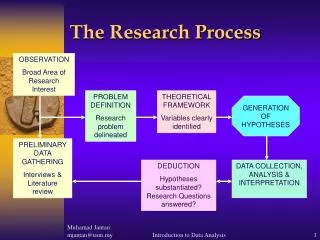
Stages in building theories and applying the scientific method • Assessing existing knowledge (literature review) • Formulating concepts and propositions (developing a model) • Stating an hypothesis • Designing the research to test the hypothesis • Acquiring the data • Analyzing the data and evaluating the results • Providing an explanation and stating new research questions
Types of Research: • Basic Research • Applied Research
Basic Research • Conducted for the purpose of developing theory • Approach may be verbal, graphical or mathematical • May inspire others to “test” the theory • May be inductively or deductively based upon observations about the behavior of variables
Applied Research • Tests a theory or theories • May compare two or more theories • May simply add support to or refute a theory • Replication on different data or different circumstances is desirable to “reproduce” results and test generalizability of theories
Types of Applied Research • Descriptive • Case Study • Survey Research • Content Analysis • Correlation • Regression Analysis (Econometrics) • Mathematical Programming
Descriptive Research • Designed to determine the current status of a subject of study • Often preliminary to other types of research • Often used to persuade the reader • Example: overview of Asian economic crisis, survey of world car market
Case Study • In-depth investigation of an individual, group or institution • Widely used in business to analyze successes and failures • Aimed at finding out “why”. Ex. How has Starbucks managed its rapid expansion during the 1990’s
Survey Research • Collecting data from a sample population to test economics theory or ascertain economic values • Experimental - create a hypothetical market situation and observe behavior to test an hypothesis
Content Analysis • Tries to judge support for a theory from analyzing the “content” of writings
Correlation • Involves collecting and analyzing data to determine whether, and to what degree, variables move together • Does not imply causality although often interpreted that way • Examples - family wealth and educational attainment, sunspots and economic output
Regression Analysis • More sophisticated form of statistical analysis which controls for the effects of other variables in relationship hypothesized to be causal • Examples - demand curve, relationship between money supply and interest rates
Mathematical Programming • Develop a set of equations describing an economic system and, using a computer, run the model to study how the system works • Optimization - linear programming • Simulation - ithink
What Makes A “Good” Topic? • It’s “doable” - data is available, you understand the methodology, it can be done in the time available. • It’s specific, not vague or general. • The question can be answered. • It’s topical - there’s current interest in it. • It matters - it has societal significance. • Most important: you like it.