The U.S. Constitution
The U.S. Constitution establishes a system of government divided into three branches: Legislative, Executive, and Judicial. Each branch has distinct powers to ensure a separation of powers that provides checks and balances. The Legislature, known as Congress, makes laws and holds the power to declare war and control the treasury. The Executive, led by the President, enforces laws and commands the military. The Judicial branch, comprising federal courts, interprets laws and can declare them unconstitutional. This framework is vital for protecting democracy and maintaining order.

The U.S. Constitution
E N D
Presentation Transcript
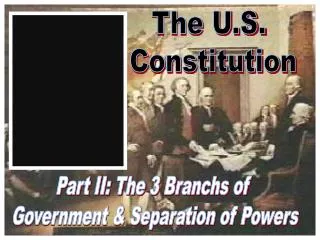
The U.S. Constitution Part II: The 3 Branchs of Government & Separation of Powers
Separation of Powers! The Constitution makes provisions to divide the powers of Gov’t into THREE BRANCHES a defined condition • Legislature – Makes laws • 2. Executive – Carries out laws • 3. Judicial – Interprets laws OGT Vocab! Law: legal document setting forth rules or standards for a society
Name that Branch The Constitution gives names to each of the THREE BRANCHES • Legislature – U.S. Congress • 2. Executive – President • 3. Judicial – Federal Courts
Congress Constitution gives the U.S. Congress the power to: OGT Vocab! • Make Laws • 2. Declare War • 3. Control Treasury • 4. Impeachment • 5. Approve Treaties • 6. Override vetoes • 7. Others Congress can still pass a vetoed law
President Constitution gives the President the power to: Bill: idea for a law • Enforce Laws • 2. Commander-in-Chief • 3. Appoint Judges • 4. Veto Powers • 5. Negotiate Treaties • 6. Grant Pardons • 7. Others OGT Vocab! President can kill or “forbid” a bill passed by Congress
Federal Courts Constitution gives the Courts the power to: • Interpret Laws • 2. Declare Laws Unconstitutional** • 3. Powers not well defined in Constitution Federal Courts: Supreme Courts Appeals Courts District Courts