Download
1 / 1
10 likes | 141 Vues
This comprehensive analysis delves into the intricate relationship between capitalism and democracy, assessing key concepts such as negative and positive liberty, the clash between economic power and political equality, and the implications of corporate influence on democratic ideals. It examines the dynamics of regulated competition, consumer sovereignty, and the role of institutions in shaping economic realities. By exploring various economic theories and psychological traits, this work provides insights into how democracy can thrive in a capitalist framework while addressing issues of equality and efficiency.

E N D
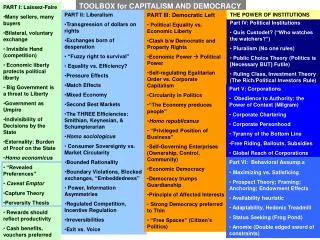
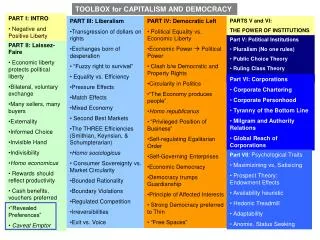
TOOLBOX for CAPITALISM AND DEMOCRACY • PART I: INTRO • Negative and Positive Liberty • PART III: Liberalism • Transgression of dollars on rights • Exchanges born of desperation • “Fuzzy right to survival” • Equality vs. Efficiency • Pressure Effects • Match Effects • Mixed Economy • Second Best Markets • The THREE Efficiencies (Smithian, Keynsian, & Schumpterarian) • Homo sociologicus • Consumer Sovereignty vs. Market Circularity • Bounded Rationality • Boundary Violations • Regulated Competition • Irreversibilities • Exit vs. Voice • PART IV: Democratic Left • PoliticalEquality vs. Economic Liberty • Economic Power Political Power • Clash b/w Democratic and Property Rights • Circularity in Politics • “The Economy produces people” • Homo republicanus • “Privileged Position of Business” • Self-regulating Egalitarian Order • Self-Governing Enterprises • Economic Democracy • Democracy trumps Guardianship • Principle of Affected Interests • Strong Democracy preferred to Thin • “Free Spaces” PARTS V and VI: THE POWER OF INSTITUTIONS • Part V: Political Institutions • Pluralism (No one rules) • Public Choice Theory • Ruling Class Theory • PART II: Laissez-Faire • Economic liberty protects political liberty • Bilateral, voluntary exchange • Many sellers, many buyers • Externality • Informed Choice • Invisible Hand • Indivisibility • Homo economicus • Rewards should reflect productivity • Cash benefits, vouchers preferred • “Revealed Preferences” • Caveat Emptor • Part VI: Corporations • Corporate Chartering • Corporate Personhood • Tyranny of the Bottom Line • Milgram and Authority Relations • Global Reach of Corporations • Part VII:Psychological Traits • Maximizining vs, Satisicing • Prospect Theory; Endowment Effects • Availability heuristic • Hedonic Treadmill • Adaptability • Anomie, Status Seeking