Download
1 / 27
270 likes | 424 Vues
This chapter delves into the various types of websites and the importance of evaluating web content for accuracy. It covers multimedia elements like graphics, audio, and video, and explains essential concepts such as plug-ins for browsers and web publishing. Additionally, it discusses e-commerce, email, instant messaging, and other internet services, highlighting the significance of netiquette in online communication. By understanding these elements, users can navigate the web more effectively and foster better online interactions.

E N D
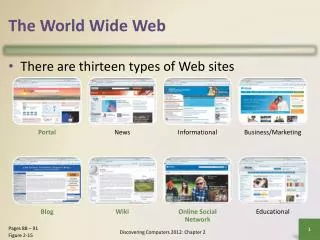
The World Wide Web • There are thirteen types of Web sites Discovering Computers 2012: Chapter 2 Pages 88 – 91 Figure 2-15
The World Wide Web Discovering Computers 2012: Chapter 2 Pages 91 – 92 Figure 2-15
The World Wide Web • Information presented on the Web must be evaluated for accuracy • No one oversees the content of Web pages Page 92 Figure 2-16 Discovering Computers 2012: Chapter 2
The World Wide Web • Multimedia refers to any application that combines text with: Discovering Computers 2012: Chapter 2 Page 92
The World Wide Web • A graphic is a digital representation of nontext information • Graphic formats include BMP, GIF, JPEG, PNG, and TIFF Page 93 Figure 2-17 Discovering Computers 2012: Chapter 2
The World Wide Web • A thumbnail is a small version of a larger graphic Page 94 Figure 2-19 Discovering Computers 2012: Chapter 2
The World Wide Web • Animation is the appearance of motion created by displaying a series of still images in sequence Discovering Computers 2012: Chapter 2 Page 94
The World Wide Web • Audio includes music, speech, or any other sound • Compressed to reduce file size • You listen to audio on your computer using a player • Streaming is the process of transferring data in a continuous and even flow Discovering Computers 2012: Chapter 2 Pages 94 – 95 Figure 2-20
The World Wide Web Discovering Computers 2012: Chapter 2 Page 95 Figure 2-21
The World Wide Web • Video consists of images displayed in motion Discovering Computers 2012: Chapter 2 Page 96 Figure 2-22
The World Wide Web • Virtual reality(VR) is the use of computers to simulate a real or imagined environment that appears as a three-dimensional space Discovering Computers 2012: Chapter 2 Pages 96 – 97 Figure 2-23
The World Wide Web • A plug-in is a program that extends the capability of a Web browser Discovering Computers 2012: Chapter 2 Page 97 Figure 2-24
The World Wide Web • Web publishingis the development and maintenance of Web pages Discovering Computers 2012: Chapter 2 Page 98
E-Commerce • E-commerce is a business transaction that occurs over an electronic network • M-commerceidentifies e-commerce that takes place using mobile devices Discovering Computers 2012: Chapter 2 Page 98
E-Commerce Discovering Computers 2012: Chapter 2 Pages 98 - 99
E-Commerce Discovering Computers 2012: Chapter 2 Page 99 Figure 2-25
Other Internet Services • E-mailis the transmission of messages and files via a computer network • An e-mail programallows you to create, send, receive, forward, store, print, and delete e-mail messages Page 101 Figure 2-26 Discovering Computers 2012: Chapter 2
Other Internet Services Discovering Computers 2012: Chapter 2 Page 102 Figure 2-27
Other Internet Services • A mailing listis a group of e-mail names and addresses given a single name • Subscribing adds your e-mail name and address • Unsubscribing removes your name Discovering Computers 2012: Chapter 2 Page 103 Figure 2-28
Other Internet Services • Instant messaging (IM) is a real-time Internet communications service Discovering Computers 2012: Chapter 2 Page 104 Figure 2-29
Other Internet Services • A chat is a real-time typed conversation that takes place on a computer • A chat roomis a location on an Internet server that permits users to chat with each other Page 105 Figure 2-30 Discovering Computers 2012: Chapter 2
Other Internet Services • VoIP (Voice over IP) enables users to speak to other users over the Internet • Also called Internet telephony Page 106 Figure 2-31 Discovering Computers 2012: Chapter 2
Other Internet Services • A newsgroup is an online area in which users have written discussions about a particular subject • Typically requires a newsreader • A message boardis a Web-based type of discussion group Page 107 Figure 2-32 Discovering Computers 2012: Chapter 2
Other Internet Services • FTP (File Transfer Protocol) is an Internet standard that permits file uploading and downloading with other computers on the Internet • Many operating systems include FTP capabilities • An FTP server is a computer that allows users to upload and/or download files using FTP Discovering Computers 2012: Chapter 2 Page 107
Netiquette • Netiquette is the code of acceptable Internet behavior Discovering Computers 2012: Chapter 2 Page 108 Figure 2-33
Summary Discovering Computers 2012: Chapter 2 Page 109