Maximizing Student Success with the Stitch-In Report Tool
210 likes | 347 Vues
The Stitch-In Report is an innovative Excel-based tool designed for career coaches at Pueblo Community College, CHEO Team, and Rutgers University to effectively track and document student progress. By using this streamlined approach, coaches can save valuable time while maintaining accurate records for grant analysis. The tool emphasizes the importance of integrating each student's experience through a cohesive process, enhancing their chances for success in their respective programs. Attend our training for a hands-on demonstration and discover best practices for data collection!


Maximizing Student Success with the Stitch-In Report Tool
E N D
Presentation Transcript
Stitch-In Report Tutorial • John West – Career Coach, Pueblo Community College • Jeremy Mares – Data Analyst, CHEO Team • Heather McKay – Chief Evaluator, Rutgers University
Introduction Rollout of the Stitch-in instrument - John Introduction to instrument training - Jeremy How this work fits in the overall evaluation - Heather
What is a “Stitch-In Report”? • An everyday, Excel-based tool for career coaches to easily track their students’ progress. • A time-saving way to document the progress of each participant and to build an accurate record. • An efficient means for collecting data for grant analysis. • Your new best friend.
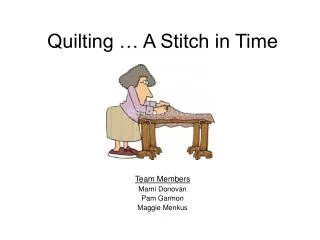
Why use this tool? • Stitch-in refers to the important process by which each student is sewn into their CHEO program and given the best opportunity for success. • Like the quilt pictured here, each piece of the student experience is stitched together in a step-by-step process.
Benefits of this tool • A career coach’s tool; designed to create a useful student case file. • Provides a useful balance of superb coaching and efficient data collection. • Designed to evolve over time, ensuring that it meets the needs of our career coaching professionals.
Live Demonstration • Become familiar with how the tool works (handouts) • Learn necessary protocol needed for data collection • Gain time-saving tricks to increase productivity • Codebook resource tool provided for easy reference
How do I get started? • Where is this student data coming from? • Institutional Research is your friend for directory information. • Create a listserv/BCC Distribution List. • Begin filling in the appropriate fields as you work with your students.
Best Practices • Handy Tools: • Autofilter - “Shift + CTRL + L” • Edit a Cell- F2/Double Left Click • Collapsible/Sizeable columns • Save As – keep the original safe and only work in the original • Print the Codebook, display it somewhere for easy reference
Guidelines • Color Nomenclature • IR Supplied Sections • Yellow – Generic student identifiers • Red – Student identifiable (FERPA protected) • Coach Supplied Sections • Blue – Gained through your work • Green – Detailed narrative log • Delimiters – the way to separate “green” text; essential for data collection. • Please retrofit any previous data from previous semesters.
Guidelines [con’t] • Beware of FERPA. Use caution when sending those group e-mails. The Listserv/BCC option will help with this tremendously. • Each year has its own tab. • Submissions – Name the file YYYYMMDD Campus Stitch-In.xslx (i.e. 20130822 PCC Stitch-In.xslx • Each college will receive their own template at the end of the conference via e-mail.
Weekly Submissions • This is a non-evaluative process. • Helps coaches to stay current and back up their work. • Coaches only need to submit their stitch-in report “as –is” (minus red columns) on Fridays before you leave for the weekend. • This will also help close that feedback loop where you can voice your opinions as our work gets underway.
You’re not alone! • Call me, don’t be afraid to just call me. • Continual support will be provided throughout the life of the project. • Follow-up training will be scheduled. • Sounding boards – weekly submissions • Evaluate and refine – evolve as needed
CHEO EvaluationRutgers University, School of Management and Labor Relations Heather McKay Director, Innovative Training and Workforce Development Research
Rutgers CWW and Evaluation • Conducted numerous evaluations and research projects in education, training and workforce throughout the US and abroad • Rutgers CWW has worked in Colorado since 2008 • Conducted three research projects in Colorado to date: online learning project, sectors project evaluation, TAACCCT Round 1
Rutgers Team • Heather McKay • Suzanne Michael • Debbie Borie-Holtz • Sara Haviland • Laura Barrett • Renee Edwards • Joseph Rua
Why Evaluate? • Federal grant and an evaluation is required • Understand the type and degree of impact of TAA on program development, academic success and employment • Identify best strategies/practices • Collect observations, insights and lessons learned to inform, refine and/or develop more effective programs/services to meet existent and emergent needs of students, colleges and industries • Identify issues/needs that can inform academic practice and public policy • Provide feedback to colleges throughout the lifetime of the grant so that changes can be made mid-course • Share information between the colleges • Tell Rutgers what you need from this evaluation
\ COETC EVALUATION QUALITATIVE AND QUANTITATIVE ANALYSES
Contact Information and Questions Heather McKay hmckay@work.rutgers.edu 609-850-9424