Comprehensive Introduction to Molecular Biology and Bioinformatics Databases
This document provides an overview of key molecular biology and bioinformatics databases essential for researchers. It introduces primary sequence databases like GenBank, EMBL, and DDBJ, as well as protein data resources such as the Protein Data Bank and SWISS-PROT. With an emphasis on the importance of these databases for the retrieval and annotation of DNA and protein sequences, this resource serves as a valuable starting point for novices and experienced researchers alike, guiding them in exploring the wealth of biological data available online.

Comprehensive Introduction to Molecular Biology and Bioinformatics Databases
E N D
Presentation Transcript
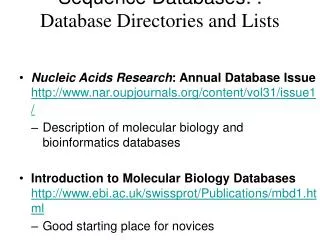
Sequence Databases: :Database Directories and Lists • Nucleic Acids Research: Annual Database Issuehttp://www.nar.oupjournals.org/content/vol31/issue1/ • Description of molecular biology and bioinformatics databases • Introduction to Molecular Biology Databaseshttp://www.ebi.ac.uk/swissprot/Publications/mbd1.html • Good starting place for novices
Primary Sequence Databases • International Nucleotide Sequence Database Collaboration http://www.ncbi.nlm.nih.gov/collab/ DNA sequences and derived protein sequences • GenBank,NCBI http://www.ncbi.nlm.nih.gov • European Molecular Biology Laboratory, EMBL http://www.embl.org/ • DNA Data Bank of Japan, DDBJ http://www.ddbj.nig.ac.jp/ • Other • Protein Data Bank - three-dimensional structures of protein
Protein Data Bank: http://www.rcsb.org • 3-dimensional structure of proteins • 1971, BNL (Brookhaven NationalLaboratories) • archive for biologicalmacromolecular crystal structures • 1980s • increase in the number of deposited structures. • 1998, RCSB(Research Collaboratory for Structural Bioinformatics) • NSF, DOE, and two units of NIH:NIGMS National Institute Of General Medical Sciences and NLM National Library Of Medicine.
Secondary Sequence Databases: SWISS-PROT/TrEMBL • http://www.expasy.ch/ • Annotated protein sequences, • 1986, developed by the SWISS-PROT groups at SIB and European Bioinformatics Institute. • 1987, maintained collaboratively by the Department of Medical Biochemistry of the University of Geneva and the EMBL Data Library (EBI). • cross-referenced to several other databases, EMBL, PROSITE pattern database and PDB."
Secondary Sequence Databases:Protein Identification Resource (PIR) • International Protein Sequence Database http://pir.georgetown.edu/ • 1988, Georgetown University Medical Center, Munich Information Center for Protein Sequences (MIPS) and the Japan International Protein Information Database (JIPID) • "a comprehensive, non-redundant, expertly annotated, fully classified and extensively cross-referenced protein sequence database in the public domain"