
Schematic and Gel Analysis of EcoNI-Digested Plasmids Containing Os11N3 Promoter Variants
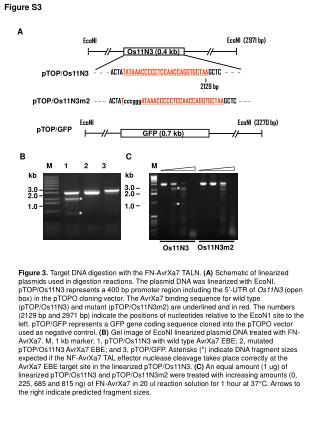
This figure illustrates the digestion of plasmid DNA containing the Os11N3 promoter region using EcoNI. Part A presents a schematic of linearized plasmids used in digestion reactions, including pTOP/Os11N3, which contains the wild-type AvrXa7 binding sequence, and pTOP/Os11N3m2, featuring a mutated sequence. Part B shows a gel image of the EcoNI linearized plasmid DNA treated with FN-AvrXa7, indicating expected DNA fragment sizes. Part C details the treatment of linearized plasmids with increasing amounts of FN-AvrXa7, highlighting predicted fragment sizes.

Schematic and Gel Analysis of EcoNI-Digested Plasmids Containing Os11N3 Promoter Variants
E N D
Presentation Transcript
Figure S3 A EcoNI (2971 bp) EcoNI Os11N3 (0.4 kb) ACTATATAAACCCCCTCCAACCAGGTGCTAAGCTC - - - - - - pTOP/Os11N3 2129 bp ---ACTATcccgggATAAACCCCCTCCAACCAGGTGCTAAGCTC --- pTOP/Os11N3m2 EcoNI EcoNI (3270 bp) pTOP/GFP GFP (0.7 kb) B C M M 1 2 3 kb kb 3.0 * 3.0 2.0 2.0 * * 1.0 1.0 * Os11N3m2 Os11N3 Figure 3. TargetDNA digestion with the FN-AvrXa7 TALN. (A) Schematic of linearized plasmids used in digestion reactions. The plasmid DNA was linearized with EcoNI. pTOP/Os11N3 represents a 400 bp promoter region including the 5’-UTR of Os11N3 (open box) in the pTOPO cloning vector. The AvrXa7 binding sequence for wild type (pTOP/Os11N3) and mutant (pTOP/Os11N3m2) are underlined and in red. The numbers (2129 bp and 2971 bp) indicate the positions of nucleotides relative to the EcoN1 site to the left. pTOP/GFP represents a GFP gene coding sequence cloned into the pTOPO vector used as negative control. (B) Gel image of EcoNI linearized plasmid DNA treated with FN-AvrXa7. M, 1 kb marker; 1, pTOP/Os11N3 with wild type AvrXa7 EBE; 2, mutated pTOP/Os11N3 AvrXa7 EBE; and 3, pTOP/GFP. Asterisks (*) indicate DNA fragment sizes expected if the NF-AvrXa7 TAL effector nuclease cleavage takes place correctly at the AvrXa7 EBE target site in the linearized pTOP/Os11N3. (C) An equal amount (1 ug) of linearized pTOP/Os11N3 and pTOP/Os11N3m2 were treated with increasing amounts (0, 225, 685 and 815 ng) of FN-AvrXa7 in 20 ul reaction solution for 1 hour at 37°C. Arrows to the right indicate predicted fragment sizes.
