
Impact of Predator Life Stages on Pea Aphid Populations: A Statistical Analysis
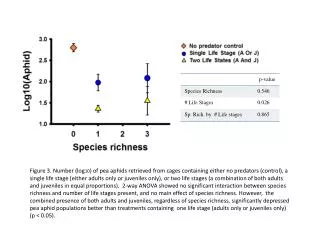
This study investigates the effects of predator life stages (adults, juveniles, both) on pea aphid populations in controlled environments. Through 2-way ANOVA, we found no significant interaction between species richness and predator life stages. However, the presence of both adults and juveniles significantly reduced pea aphid populations compared to treatments with a single life stage, regardless of species richness (p < 0.05). This highlights the importance of combining predator life stages for effective aphid management.

Impact of Predator Life Stages on Pea Aphid Populations: A Statistical Analysis
E N D
Presentation Transcript
Figure 3. Number (log10) of pea aphids retrieved from cages containing either no predators (control), a single life stage (either adults only or juveniles only), or two life stages (a combination of both adults and juveniles in equal proportions). 2-way ANOVA showed no significant interaction between species richness and number of life stages present, and no main effect of species richness. However, the combined presence of both adults and juveniles, regardless of species richness, significantly depressed pea aphid populations better than treatments containing one life stage (adults only or juveniles only) (p < 0.05).