Download
1 / 25
250 likes | 350 Vues
Explore the optimal path for CO2 emissions based on numerical solutions and compare it with Socolow and Lam's approach. Learn how to account for inertia in emission change and trends. Concluding comments offer insight on achieving maximum emission reduction efficiency.

E N D
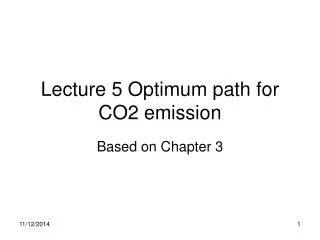
Lecture 5 Optimum path for CO2 emission Based on Chapter 3
3.3 Optimum path for CO2 emission without considering the inertia of change
3.4 Accounting for the inertia in the quantity of emission and in the trend of emission.
3.5 Numerical Solutions to the optimal path for CO2 emission
3.6. Comparison with the Socolow-Lam Optimum Path • Socolow and Lam (2006) present an optimum path for CO2 emission for the years 2005 onwards that begins at the current observed value of 8 and reaches a steady state value of 3, such that the maximum change in et in any period is minimized. This implies that the rate of reduction in et must be constant. Hence, the emission path from e0 = 8 to the steady-state value eT = 3 must be a straight line because any deviation from a straight line would cause the rate of reduction to be larger than the minimum achievable. See Socolow and Lam (2006, Figure 7).