Understanding the Relationship Between Heat, Work, and Internal Energy in Thermodynamics
This section explores the fundamental concepts of heat, work, and internal energy in thermodynamic systems. It emphasizes that an object contains only internal energy, while heat and work are forms of energy transferred to or from a system. Using a practical example, it illustrates how heating water in a flask creates steam, leading to expansion and work done against the balloon's walls. Additionally, it clarifies how work is defined in terms of pressure and volume changes, with implications for gas expansion and compression.

Understanding the Relationship Between Heat, Work, and Internal Energy in Thermodynamics
E N D
Presentation Transcript
1. Thermodynamics Chapter 10
2. Relationship Between Heat and Work Section 1
3. Heat, Work, and Internal Energy Heat and work are energy transferred to or from a system. An object never has “heat” or “work” in it; it has only internal energy.
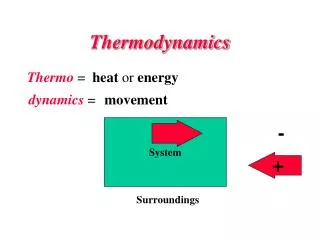
A system is a set of particles or interacting components considered to be a distinct physical entity for the purpose of study.
The environment the combination of conditions and influences outside a system that affect the behavior of the system.
4. Heat, Work, and Internal Energy Picture this . . .
A flask with water has a balloon over the mouth of the flask and it is heated until the water boils.
What happens to the balloon?
Water changes phase and becomes steam and the volume of the steam increases.
This expansion provides a force that pushes on the walls of the balloon and does work and the internal energy of the steam decreases.
5. Heat, Work, and Internal Energy In thermodynamic systems, work is defined in terms of pressure and volume change.
This definition assumes that P is constant.
6. Heat, Work, and Internal Energy If the gas expands, as shown in the figure, DV is positive, and the work done by the gas on the piston is positive. If the gas is compressed, DV is negative, and the work done by the gas on the piston is negative. (In other words, the piston does work on the gas.)