Towards Completely Automatic Decoder Synthesis
Explore the process of automatic decoder synthesis, focusing on decoder existence checking, CNF encoding, and experimental results to improve system implementation efficiency.

Towards Completely Automatic Decoder Synthesis
E N D
Presentation Transcript
Towards Completely Automatic Decoder Synthesis Hsiou-Yuan Liu, Yen-Cheng Chou, Chen-Hsuan Lin, and Jie-Hong Roland Jiang ALComLab EE Dept/ Grad. Inst. of Electronics Eng. National Taiwan University
Outline • Introduction • Decoder existence checking • Decoder synthesis • Experimental results • Conclusions ICCAD 2011
Introduction Encoder 0,1,1,0,0,… 1,0,1,0,1,… Decoder ICCAD 2011
Introduction • Decoding process under a bounded observation window Encoder Decoder …, ok, ok+1, ok+2, ok+3, ok+4, ok+5, … … ij ij+1 ij+1 … ij+2 ICCAD 2011
Introduction • Example 1/1 1/1 0/0 0/1 0/0 1/0 q0 q1 q0 q1 1/0 0/1 ICCAD 2011
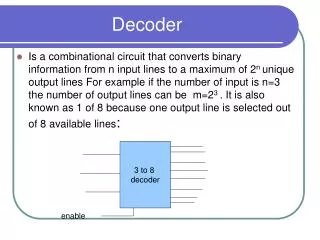
Introduction • Encoding/decoding scheme plays key roles in various applications, including • Communication, • Signal processing, • Cryptography, … • Designing a decoder can be more difficult than designing an encoder • Automatic decoder synthesis helps a designer effectively and correctly implement his/her system ICCAD 2011
Introduction • Basic assumptions: • Encoder can be sequential • Combinational encoder is a special case • Can be decoded with observation window of size 1 • Steady state behavior is of main concern • Initial transient behavior is neglected • Decoder has finite memory • Bounded observation window ICCAD 2011
Prior Work • Decoder synthesis [Shen et al. ICCAD09] • Bounded decoder existence checking • Decoder generation using ALLSAT • Halting algorithm [Shen et al. FMCAD10] • Unbounded decoder existence checking (with flaw) ICCAD 2011
Contributions • Theoretically, guaranteed decoder existence/inexistence checking with simplified formulation • Practically, fast computation • Simplified CNF encoding • Interpolation for decoder synthesis ICCAD 2011
Decoder Existence Checking • Notation input output x y T current state s s' next state transition relation ICCAD 2011
Decoder Existence Checking • Decoder exists under window (-n,p) iff is UNSAT T–n T–1 T0 T1 Tp … … T*0 T*–n T*–1 T*1 T*p … … ICCAD 2011
Decoder Existence Checking • Decoder does not exist iff is SAT for some n and p, where ICCAD 2011
Decoder Existence Checking • Decoder does not exist iff is SAT for some n and p, where ICCAD 2011
Decoder Existence Checking T–n T–1 T0 T1 Tp … … T*0 T*–n T*–1 T*1 T*p … … L L L ICCAD 2011
Decoder Existence Checking solve M(n,p) n := 0 p := 0 encoder no SAT? decoder exists return (n, p) yes solveM(n,p)(L(LL)) yes n := n+1 p := p+1 SAT? no decoder return counterexample no ICCAD 2011
T–3 T*–3 Decoder Existence Checking • Incremental timeframe expansion • Expand from outside T–2 T–1 T0 … T*0 T*–2 T*–1 … ICCAD 2011
T–1 T–2 T–3 T–1 T–2 T*–1 T*–3 T*–2 T*–2 T*–1 Decoder Existence Checking • Incremental timeframe expansion • Expand from inside T0 … T*0 … ICCAD 2011
Decoder Existence Checking • Disjunctive conditions Not good for CNF encoding ICCAD 2011
Decoder Existence Checking • CNF encoding of disjunctive conditions • E.g., Let = 1+2+3 = (C1C2C3)+(C4C5)+(C6C7) Let = (C1+1) (C2+1) (C3+1) (C4+2) (C5+2) (C6+3) (C7+3) (1+2+3) and are equisatisfiable ICCAD 2011
Decoder Existence Checking • Incremental CNF encoding of disjunctive conditions • E.g., Let = 1+2+3 = (C1C2C3)+(C4C5)+(C6C7) Suppose i are appended incrementally Let = (C1+1) (C2+1) (C3+1) (0+1+1) (C4+2) (C5+2) (1+2+2) (C6+3) (C7+3) (2+3+3) and (03) are equisatisfiable ICCAD 2011
Decoder Existence Checking solve M(n,p) n := 0 p := 0 encoder no SAT? decoder exists return (n, p) yes solveM(n,p)(L(LL)) yes n := n+1 p := p+1 SAT? no decoder return counterexample no ICCAD 2011
Decoder Synthesis • Craig interpolation theorem: • For (A B) UNSAT, there exists an interpolant I such that 1. A I 2. B I UNSAT 3. I refers only to the common variables of A and B I B A ICCAD 2011
Decoder Synthesis • The interpolant corresponds to the desired decoder A 1 T–n T–1 T0 T1 Tp … … 0 T*0 T*–n T*–1 T*1 T*p … … B ICCAD 2011
Experimental Results • Our decoding system “Decosy” implemented in ABC using C language • Experiments conducted on Linux machine with Xeon 2.53 GHz CPU and 48GB RAM • Final circuits mapped into mcnc.genlib library ICCAD 2011
Experimental Results • Comparison on decoder generation time *Prior work [14] implemented in OCaml. ICCAD 2011
Experimental Results • Comparison on decoder existence checking and decoder generation *Prior work [14] implemented in OCaml. ICCAD 2011
Experimental Results • Comparison on decoder inexistence checking *Prior work [14] implemented in OCaml. ICCAD 2011
Conclusions • We presented a sound and complete approach to decoder synthesis • An effective incremental SAT solving solution was proposed for decoder existence checking • Craig interpolation was used for effective decoder generation • Experiments showed robust and fast computation (with synthesis quality comparable to prior work) ICCAD 2011
Thank You for Your Attention • Questions? ICCAD 2011