Sockets
This article covers the concept of sockets in Java and their role in establishing TCP/IP connections. A socket is created on both the client and server ends of a connection, facilitating bi-directional communication through input and output streams. Topics include socket creation on a specified port, waiting for client connections, and code examples for both client and server applications. You'll learn how to implement a basic echo server, which responds to client messages until "goodbye" is received, and how to test it using Telnet.

Sockets
E N D
Presentation Transcript
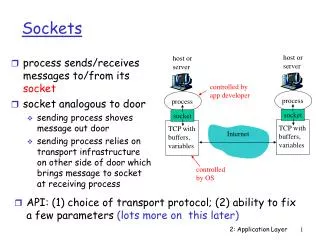
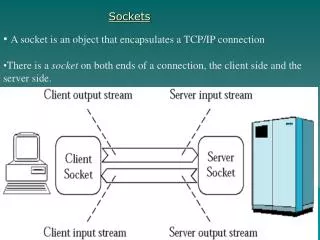
A socket is an object that encapsulates a TCP/IP connection • There is a socket on both ends of a connection, the client side and the server side. Sockets
A socket has two streams, one for input and one for output. • In a client/server application: • the client’ output stream is connected to the server’s input stream • the server’s output stream is connected to the client’s output stream • Typical scenerio: • Server program creates a socket at a certain port and waits until a client • requests a connection • Client program creates a socket and attempts to make a connection • Once the connection is established the client and server communicate • Client closes connection.
A server application waits for the client to connect on a • certain port. We choose 8888 • To listen for incoming connections, use a server socket • To construct a server socket, provide the port number • ServerSocket server = new ServerSocket(8888); • Use the accept method to wait for client connection: • Socket s = server.accept(); • //accept() will wait until a connection is established .. Java will • notify when this happens • Now can open input/output to socket: • s.getInputStream provides reference to • the socket’s input stream A Server Program
Syntax to create a socket in a Java program • Socket s = new Socket(hostname, portnumber); • Code to connect to the HTTP port of server, java.sun.com • final int HTTP_PORT = 80; • Socket s= new Socket("java.sun.com",HTTP_PORT); • again, now access this sockets input and output stream • InputStream in = s.getInputStream() • OutputSteam out = s.getOutputSTream • Client socket should close when done: • s.close(); • s. Client Program
Let’s look at a Server program which ‘echo’s all text Receives until ‘goodbye’ is received. … we’ll test it with Telnet (localhost , port=55555) netSEx5.java