Download
1 / 7
70 likes | 206 Vues
This document summarizes findings from the Helium Release in SiC Tile HAPL Workshop held at the University of Rochester on November 8 and 9, 2005. Key points include the behavior of helium in CVD SiC at various temperatures, showcasing that at 1273K, helium forms nano-sized bubbles within the matrix, while at 1673K, it creates larger bubbles at grain boundaries. The report also discusses interactions between helium and vacancies and their implications for helium transport and bubble formation, emphasizing the significance of these findings for future materials research.

E N D
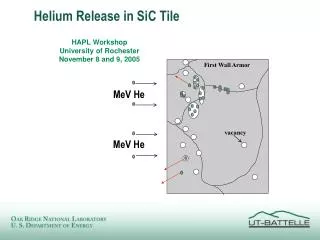
Helium Release in SiC Tile HAPL Workshop University of Rochester November 8 and 9, 2005 First Wall Armor MeV He vacancy MeV He
Cavity Formation in CVD SiC 1273K, 10 dpa, 600 appmHe • At 1273K, helium mostly stays within the matrix in nano-sized bubbles on stacking faults and other types of defects. • At 1673K, helium forms larger bubbles on grain boundaries. Smaller bubbles are also present. 1673K, 10 dpa, 600 appmHe ORNL / Kyoto University
50nm 50nm Helium Transport in Irradiated CVD SiC at 1673K 60dpa 60dpa (b) (a) 1673K, 60 appmHe/dpa Irradiated surface Beam direction 50nm (c) GB 5dpa (c) SiO2 layer He distribution (a) GB (b) ORNL / Kyoto University
Helium transport / retention in CVD SiC Quick summary: • At <~800C, helium mostly stays within matrix. • At 1000 - 1300C, majority of helium goes to grain boundaries. • At 1400C, substantial pipe-diffusion and GB diffusion of helium to free surface occur. • Without sufficient atomic displacement, blisters develop and lead to exfoliation. The situation for SiC is very similar to where we were with tungsten a few years ago…. Vacancy - helium interactions: • Helium-vacancy complexes easily form, similar to metals. • TDS measurement indicates He release at temperatures consistent with vacancy diffusion Dislocation - helium interactions: • Likely key mechanism of long-range helium transport. • Understanding is currently poor.
Weak Beam / Bright Field Image Comparison10 dpa at 1273 K, 1x10⁻⁵ dpa/s ORNL / Kyoto University • Matrix bubbles in the dual-beam irradiated sample are often clustered on <111> loops.