Understanding Woody Plant Growth: Photosynthesis to Root Systems
170 likes | 282 Vues
Dive into the fascinating world of woody vegetation growth! This guide covers essential topics, including how woody plants photosynthesize and grow, the importance of shoots and roots, and the impacts of aspect and elevation. Learn about the intricate structures like bark, cambium, and xylem that play vital roles in tree development. Discover how environmental factors influence growth and the natural defense mechanisms trees employ against wounds. Whether you're a novice or an expert, this overview offers valuable insights into the complexities of tree life.


Understanding Woody Plant Growth: Photosynthesis to Root Systems
E N D
Presentation Transcript
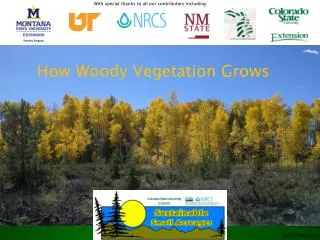
With special thanks to all our contributors including: How Woody Vegetation Grows UNCE, Reno, Nev.
Topics to be covered: • How woody plants photosynthesize • How woody plants grow • Shoots and roots • Aspect and elevation considerations • Additional Resources • this is just the tip of the iceberg!
Tree growth begins with photosynthesis to produce new wood when the growing season begins.
Bark Cambium Earlywood Heartwood Latewood Sapwood How a Tree Grows • Seed - reproduction • Leaves - photosynthesis (carbon capture) • Roots - water & nutrient uptake • Bark - protection • Cambium/buds - growth • Xylem - water transport (up) [dead] • Phloem - carbohydrate transport (down)
Outer Bark Phloem Cambium Sapwood Heartwood
Shoot Growth Woody Stem Structure
Terminal leader One year’s growth 6th year Meristems: annual growth can also be seen in the branching patterns of many tree species (esp. conifers) 5th year 4th year 3rd year 2nd year 1st year
Roots • Two main types • Taproot • Fibrous root (pines) • Most roots are found in top 18” of soil • Up to 50% in the top 6” • Root systems can occupy an area 4-7 times the surface area occupied by the crown AVOID DAMAGE! Healthy trees have a healthy, expanding root system, injured roots may lead to dead branches above NC State Ext.
Rate of root grow varies at different times of the year • Graft unions can form on roots • Can move disease from one tree to another (Armillariaroot disease –most important in Rocky Mtn. Region) Armillaria Sign: Mycelialfans under the bark. USDA Forest Service
How a Tree Grows • Increase size by growing regions or meristems • Terminal buds - height • Cambium – width (diameter) • Most forests are regenerated sexually • Seed dispersal is required • Exceptions: aspen (and others) • Environmental factors: • amount of light (forest gap) • available moisture (mineral soil) • temperature (dormancy & germination)
Trees are Tough! Wound Response • Trees have a natural defense response to wounds and pruning cuts. • Trees can compartmentalize the wound thus preventing the spread of decay organisms NC State Ext.
Pine life cycle Lodgepolepine forests usually end with a stand replacing fire every 200-350 years (USFS-RMRS)
Aspect Influence N • Cool • Moist Dense regeneration and high competition for sunlight and nutrients • Warm • Dry Widely spaced trees lack moisture for growth and germination is hindered • Wetter side • “Rain Shadow” S W E
Resources(there are too many to list) • CSFS • http://csfs.colostate.edu/ • CSU Ext. Trees and Woodlands • http://www.ext.colostate.edu/sam/trees.html
Now what? • Identify all of the trees and shrubs on your property (and nearly adjacent areas should also be looked at, elms). • Select your key species and cover type. • Consider your objectives for this resource.