Exploring Projectiles at an Angle in Physics
130 likes | 166 Vues
Understand the physics behind projectiles at an angle with examples and key points. Learn velocity equations, max height, range, and more with practical demonstrations.


Exploring Projectiles at an Angle in Physics
E N D
Presentation Transcript
Projectiles at an Angle Physics Mrs. Coyle
Projectiles at an Angle http://www.physicsclassroom.com
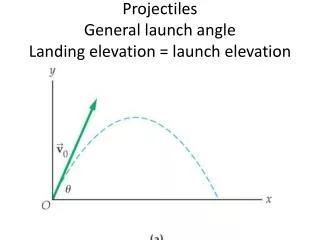
Projectiles at an Angle • Motion in two dimensions • x-axis constant velocity • y-axis constant acceleration • Parabolic trajectory
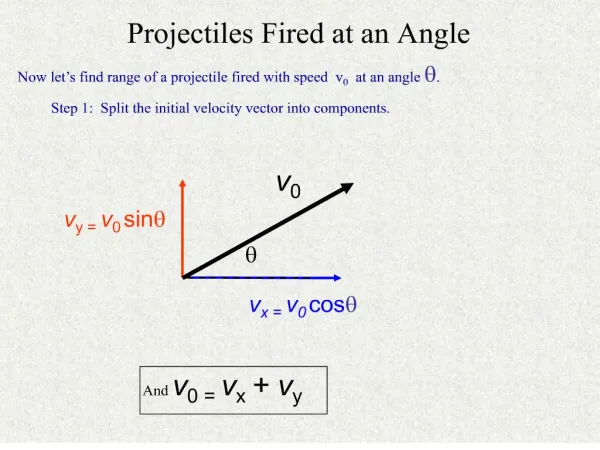
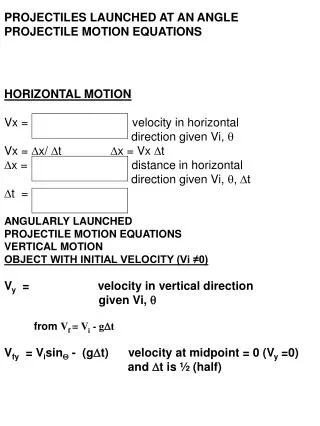
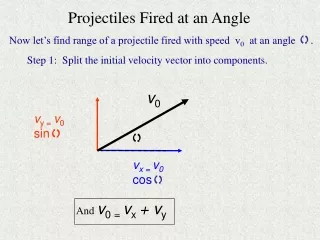
Initial Velocity • vxi=vcosq • vyi=vsinq v
Equations for Projectiles at an Angle • Initial Velocity is at an angle with the horizontal • vx=constant • vy=vyi+at a=-10m/s2 • Dy=vyit+ 1at2 2
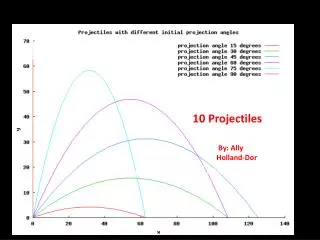
Additional Key Points • At the max height: vy=0 vx=constant=vxi • Maximum range when q=45 degrees in the absence of air resistance. • Complementary angles result in the same range. • Symmetry • Resultant velocity is tangent to the curve at the point of study.
Demonstration Link Projectiles at an Angle
Example 1 An arrow is shot with an initial x velocity of 5m/s and an initial y velocity is 15m/s. • How much time will pass for the projectile to reach max height? • What is the max height? • What is the range? Answer: a) t=1.5s , b)y= 11.25m, c) x=15m
Example 2 A cannonball is shot with an initial x velocity of 60m/s and an initial y velocity of 25m/s. a)What is the max height? b)What is the range?Answer: a) t=2.5s, y=31.25m b) x=300m
Example 3 Using vx=vcosq, vy=vsinq A cannonball is shot at 60 degrees with an initial velocity of 40m/s. a)What is the max height? b)What is the range? c)At what angle should the projectile be shot to achieve max range and what is the max range? a)Vx=20m/s, Vy=34.64m/s, t max=3.5s, y=61mb) 140m, c) 45o , 163m