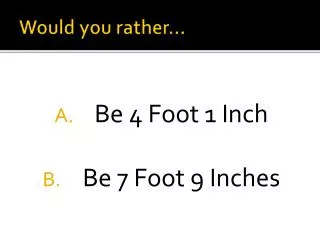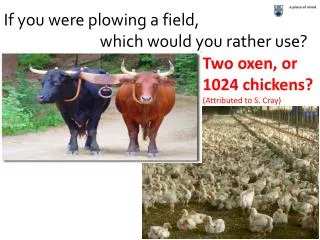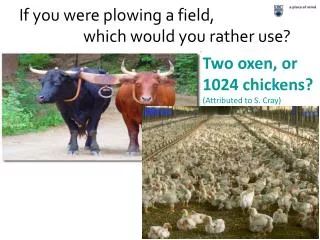
Which would you rather have?
This session delves into the concept of conservation as presented by Piaget, explaining why younger children struggle with conservation tasks. It highlights that children in the pre-operational stage primarily perceive the world through appearance rather than underlying principles, leading to misconceptions about quantity, mass, and volume. Key tests of conservation, such as liquid quantity and mass, are dissected, along with suggestions for refining these tests to enhance their validity. Homework involves discussing the real-life applications of conservation principles and how they are acquired.


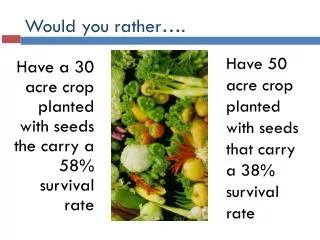
Which would you rather have?
E N D
Presentation Transcript
Pre-operational stage (intuitive) • A child’s thinking is dominated by how the world looks, not how the world is. • It doesn’t understand that redistribution of material does not affect mass, volume or number. • Conservation is the ability to understand that things remain the same even if appearance changes
Tests of Conservation • Liquid quantity • Number • Mass
Tests of conservation • According to Piaget, the ability to conserve does not appear until the stage of concrete operations (about 7 years) when the child develops mental rules of: • Compensation • Reversibility • These rules are called operations
Tests of conservation • Based on the problems we’ve already encountered with Piaget’s methods, can you identify any difficulties with these tests of conservation?
Tests of conservation • Asking the same question twice • The meaning of ‘more’ • Lack of ‘human sense’
Redesign one of Piaget’s tests of conservation to increase its validity • You can use any of the materials in the room • You can alter the task content, task structure and/or the instructions/questions • All of your changes must be justified
Alternative tests of conservation • Asking only one question (Rose & Blank, 1974; Samuels & Bryant, 1984): • 5-6 year old children perform better with one question than two • Giving the transformation a meaningful context (McGarrigle & Donaldson, 1974; Light et al, 1979) • Significant increase in 5-6 year olds’ correct responses
Homework • Answer the questions on the VLE using the discussion forum provided • These are designed to make you think about how the principle of conservation is acquired and used in ‘real-life’ • You are only required to post one answer but you may wish to respond to other people’s ideas too!