Download
1 / 11
110 likes | 217 Vues
This report explores the concept of sustainable power in the Indian context, highlighting the critical need for a balanced mix of conventional and renewable energy sources to meet India’s growing energy demands. With primary energy consumption doubling from 1990 to 2012, India now stands as the 4th largest energy consumer globally. The report discusses sustainability's role beyond mere buzzwords, addressing challenges such as land acquisition, social and environmental impacts, and regulatory hurdles. It also outlines pathways for creating a sustainable energy future that respects community rights and promotes energy security.

E N D
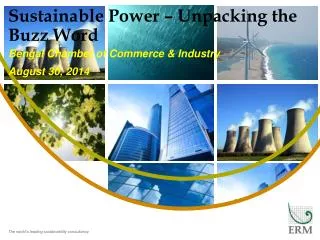
Sustainable Power – Unpacking the Buzz Word Bengal Chamber of Commerce & Industry August 30, 2014 The world’s leading sustainability consultancy
India’s Growth & Energy Needs – Some Perspectives Primary Energy consumption doubled from 1990 to 2012 3rd Largest Economy in terms of PPP 4th largest energy consumer in the world Centre for energy demand shifting from OCED to Asia (India & China) Critical need to promote energy security For 9% GDP growth, energy supply needs to grow 4 – 5 times and generation capacity; 6-7 times Ensuring sustainability in energy supply & use Addressing soc. Dev.; H,S & E needs of the people
India’s Power Sector – An Overview • Installed capacity stands at 2,28,721.73 MW in 2013 (Central Electricity Authority) - 77 times growth from 1st Five Year Plan period • Contribution in Installed capacity – State sector 40%; Private Sector 32%; Central 28% (Ministry of Power, 2013)
India’s Power Sector – An Overview contd. India: Power Generation by Fuel Source BRICS: Power Generation by Fuel Source
India’s Power Sector – An Overview contd. Distribution of Installed Capacity (Renewables) Average Energy Deficit
Sustainable Power in the Indian Context • International focus equates sustainable power with renewable energy • Drivers – (i) reduce dependency on conventional hydrocarbons; (ii) promote “cleaner” fuel based energy sources • In the Indian context, such a simplistic view may not be the best option. Why?
Sustainable Power in the Indian Context contd. • Therefore, in the Indian context, to be more than merely a buzz word sustainable power will perforce have to: • Be consciously de-linked from the preoccupation with the type of fuel source • Encompass a judicious mix of conventional sources and renewables • Understand and address the major challenges linked to each source • Lead to the meeting of India’s energy security needs
Sustainable Power in the Indian Context - Challenges • Land acquisition, resettlement and rehabilitation – the ‘curse of resources’ • Social, environmental, health and safety issues • Regulatory impediments and weak governance • Infrastructure needs • Financial health of state power utilities
Sustainable Power in the Indian Context – Way Forward • Land acquisition, resettlement and rehabilitation • Free, prior, informed consent • Market valuation and payment of compensation as per LA Act at the minimum • Respect for customary rights, communal lands, religious and cultural heritage; especially of tribal and vulnerable communities • Innovative mechanisms to include impacted stakeholders as partners in projects • Addressing regulatory hurdles and governance issues • Streamline regulatory processes and ensure time bound clearances • Automatic approvals in case of failure by state to provide verdict on time • Transparency & fairness in decision making and availability of information
Sustainable Power in the Indian Context – Way Forward contd. • Social, Environmental, Health & Safety Issues • Compulsory EIAs and SIAs; preferably Cumulative Impact Assessment (CIAs) for all power development projects – draft separate guidelines if required for renewables • Create and enforce guidelines for phasing out and disposal of out dated equipment • Link community interventions and investments to mitigate project impacts (via CSR) • Creation of a nation wide database of large power projects, identified impacts and mitigation of the same