Download
1 / 10
100 likes | 243 Vues
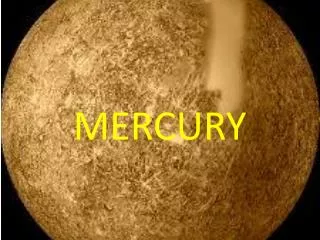
Mercury, with a diameter of 4,875 km, is the smallest planet in our solar system, just about one-third the size of Earth. It experiences extreme temperature fluctuations, ranging from 400°C during the day to -185°C at night, due to its thin atmosphere. Orbiting 57.9 million km from the Sun, it has a day that lasts 58.6 Earth days and a year of only 88 Earth days. Heavily cratered, Mercury's surface lacks significant atmospheric protection, resulting in its unique geological features. Named after the Roman god Mercury, it has fascinating myths and scientific insights.

E N D
Marvelous Mercury By: Hannah Paterson and Nicole Erickson
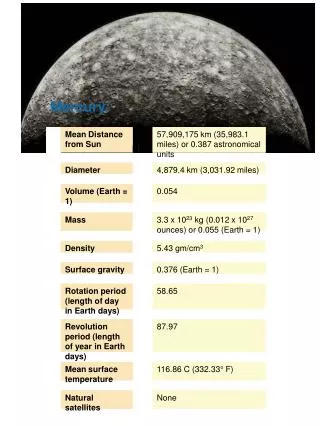
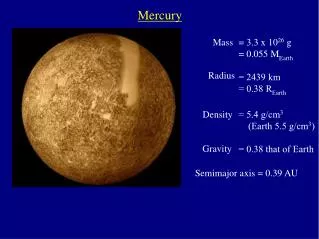
Diameter and size • Diameter= 4,875km • About 1/3 of Earth’s diameter • Earth= 12, 750km 4, 875km
Gravity • .38 gravitational force, Earth= 1 • You would weigh 38% of your weight
Distance from the Sun • 57.9 million km from the sun • Earth= 150 million km
Length of day and year • Day=58.6 earth days • Year= 88 earth days
Temperature • 400˚ Celsius to -185 ˚ Celsius • Really hot during day, freezing at night • Mercury has a huge temperature change
Surface features • Heavily cratered • Lots of craters because the atmosphere doesn’t hold them out • Terrestrial, made of solid rock
Atmosphere • Little or no atmosphere • Hydrogen, helium, oxygen
Mythology • Named for the god Mercury • In Greek, Hermes, the messenger of the gods
Bibliography •National earth science. “ Mercury” windows to the universe. NESTA, 2010. 3/1/11 • “Mercury”. Universe encyclopedia. American edition 2009. print. • Smithsonian. “Mercury facts” National air and space museum. 3/1/11. web. • Sparrow, Giles. Mercury. Singapore: Heinemann Library, 2001. print • Sparrow, Giles. Cosmos. London: Quercus Publishing, 2007. Print