Guiding Question…
This presentation explores the pervasive role of propaganda in Nazi Germany, examining why the German people permitted the regime to thrive. It provides a comprehensive definition of propaganda, highlighting its function in shaping public opinion through biased and emotionally charged information. The audience will learn about various propaganda techniques, such as bandwagon appeals, testimonials, and fear tactics, through examples like children's literature and political posters. The session will also analyze the visual symbols and messages used to instill anti-Semitic sentiment and ensure loyalty to the Nazi regime.

Guiding Question…
E N D
Presentation Transcript
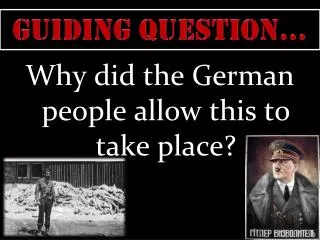
Guiding Question… Why did the German people allow this to take place?
What is Propaganda? Biased information Simplifies complex issues or ideas Created to shape public opinion and behavior The spreading of information to manipulating public opinion to gain support for one’s cause True, partially true, or blatantly false information Plays on emotions Symbols, images, words, or music
Used as instructional resources in German schools. Anti-Semitic Children’s Books Trust No Fox in the Green Meadow and No Jew on His Oath The Poisonous Mushroom
Common Propaganda Techniques • Bandwagon • Testimonial • Plain Folks • Transfer • Fear/Card Stacking • Glittering Generalities • Name-calling
Bandwagon "Greater Germany: Yes on 10 April" (1938). Appeals to a person’s desire to be on the winning side
Testimonial • Endorsements to connect a famous person with a product or ideal “sell” the product or ideal. I know, I know this is the only example I could find. No, Tiger is NOT a Nazi!
Plain Folks An attempt to convince the public that the views reflect those of the “common person.” The image of the German worker shows him bearing the weight of people with disabilities who are characterized as pale or animal faced.
Transfer Used to transfer negative feelings for one object to another An anti-semitic poster published in Poland in March 1941. The caption reads, "Jews are lice; They cause typhus."
Fear/Card Stacking Presents information that is positive and omits information contrary to it.
Glittering Generalities Emotional-appealing words to invoke powerful emotions such as: honor, glory, love of country, and freedom
Name-calling Attempts to arouse prejudice among the public by labeling the target something that the public dislikes
Making a leader • Nazi propaganda idolized Hitler • Under the Nazi regime, Germans were expected to pay public allegiance to the Hitler such as giving the Nazi salute and greeting others on the street with “Heil Hitler!”
Propaganda Facts • Nazi propaganda frequently stressed the power of a mass movement to propel the country forward, hence the upward angle of the hands. Millions of German young people were won over to Nazism in the classroom and through extracurricular activities.
Please use your corresponding worksheets with the next set of slides
Group Work Instructions • Answer all questions in complete sentences. Have one member to write the answers and one member to present. • What is the Nazi’s point of view based on this cartoon? • The most effective posters use symbols that are unusual, simple, and direct. What symbols (if any) are used in the poster and what do they symbolize? • Explain why this cartoon is persuasive? • What does the Nazi Government hope the audience will do as a result of this cartoon?
“The Spider” This cartoon appeared in the 26th edition of an anti-Semitic weekly newspaper in 1934. It reads, "The Spider. Many victims are trapped in the web, caught by flattering words. Rip the web of deceit and free German youth."
"Behind the enemy powers: the Jew." What does the title mean?
“Illustrating the Jew as a devil ” German Newspaper
‘Jews Poison”"Just wait, we'll put a stop to your dirty tricks."
“Weakness Costs” • Daily cost to the state of maintaining one chronically ill person (5.5 marks) could be better spent supporting an entire healthy German family.
Propaganda Poster • Create an advertisement using two of the propaganda terms. • You may wish advertise a product or promote a cause. • Your ad must cover an entire page (construction sheet) • Your ad must include color. • Due Date: You cannot use PowerPoint!!!