Answer set programming
This document discusses the fundamentals of Extended Logic Programs (ELPs) and their semantics in Answer Set Programming (ASP). It covers strong negation, integrity constraints, and default rules while providing examples that illustrate stable models and answer sets. Various types of rules, including definite and normal clauses, are explained alongside their logic interpretations. The complexity class of problems associated with ELPs, particularly in relation to decision-making about answer sets, is also addressed, highlighting the computational aspects of ELPs through examples.

Answer set programming
E N D
Presentation Transcript
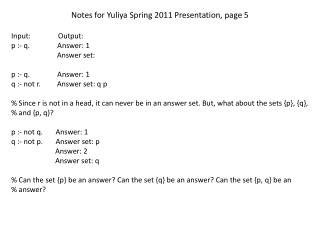
Answer set programming See Eiter et al 2009
Motivation: strong negation Programme: man(dilbert). single(X) :- man(X), not husband(X). husband(X) :- man(X), not single(X). Expressing negative fact: - single(dilbert)
Motivation: strong negation (2) Negation asfailure: walk :- at(A,L), crossing(L), not train_approaches(L). Whatifobservationincomplete? (e.g. not havinglooked) Strong negation: walk :- at(A,L), crossing(L), - train_approaches(L). Requirestoknowthattrainis not approaching!
Motivation: Integrity constraints edge(1,2). falsity :- not falsity, edge(X,Y), red(X), red(Y). Which are stable models? Alternative Notation in Programme: :- edge(X,Y), red(X), red(Y).
Motivation: default rules A bird flies bydefault: flies(X) :- bird(X), not - flies(X). penguin(tweety). bird(X) :- penguin(X). - flies(tweety). bird(ducky).
Motivation: disjunction woman(X) man(X) :- person(X).
Extended Logic Programs Definition: An extended logic program (ELP) is a finite set of rules a :- b1,…bm, not c1,…, not cn (n,m ≥ 0) where a and all bi,ci are atoms or strongly negated atoms in a first-order language L.
Semantics of ELPs Compilationto Normal Programms: • Foreach negative literal „-p(X)“ • translateitinto „notp(X)“ • addtheclause: falsity :- not falsity, p(X), notp(X). • Select thestablemodelsoftheresultingprogram P‘. These arecalledtheanswersetsof P. • An atomaisgiven a threevaluedview: • Eitheraistrueornotaistrueor a isundefined
Example ELPs Given ELP P: true. trivial :- true. a :- true. -a :- true. Programme P‘: true. trivial :- true. a :- true. nota :- true. falsity:- a, nota, not falsity. Trying to find a stable model: I={true,a,nota} GLI(P‘)={ true. trivial :- true. a :- true. nota :- true. falsity:- a, nota. } I is not a fixpoint!
Example ELP (2) sci=Science Citation index ma=Microsoft Academics website(ma). website(sci). up(S) :- website(S), not –up(S). -query(S) :- -up(S). query(sci) :- not -query(sci), up(sci). query(ma) :- not -query(ma), -up(sci), up(ma). error :- -up(sci), -up(ma). Single answer set: M={website(sci),website(ma), up(sci), up(ma), query(sci)}
Example ELP (3) website(ma). website(sci). up(S) :- website(S), not –up(S). -query(S) :- -up(S). query(sci) :- not -query(sci), up(sci). query(ma) :- not -query(ma), -up(sci), up(ma). error :- -up(sci), -up(ma). -query(S) :- not query(S), -reliable(S). -up(sci). -reliable(ma) Two answer sets: M= {website(sci),website(ma), -up(sci),up(ma), -reliable(ma), -query(sci),query(ma)} {website(sci),website(ma), -up(sci),up(ma), -reliable(ma), -query(sci),-query(ma)}
Disjunction • Definite clauses/definite rules • A :- L1, … , L_n • All L_i are positive literals (i.e. atoms) • Normal clauses/normal rules • A :- L1, … , L_n • All L_i are positive or negative literals (i.e. atoms or negated atoms) • Extended logic programmes as syntactic sugar for normal logic programmes With or without function symbols!
Extended disjunctive logic programmes Definition: An extended disjunctive logic program (EDLP) is a finite set of rules: a1… ak :- b1,…bm, not c1,…, not cn (k,n,m ≥ 0) where all ai,bi,ci are atoms or strongly negated atoms.
Semantics of Extended Logic Programmes Definition: An interpretation I is a model of • a ground clause C: a1… ak :- b1,…bm, not c1,…, not cn denoted I |= C, if either {b1,…bm} ⊈ I or {a1,…,ak,c1,…,cn}I≠{} • a clause C, denoted I |= C, if I |= C‘ for every C‘ ∈ {C}* • a program P, denoted I |= P, if I |= C for every C ∈ P*
Answer Set Definition: M is an answer set of the extended disjunctive logic programme P iff M is a minimal model of GLM(P). Note: No, one or multiple answer sets may exist for a given programme P. Note: for non-disjunctive P, a minimal = the least Example: man(dilbert). single(X) husband(X) :- man(X). M1 = {man(dilbert),single(dilbert)} M2 = {man(dilbert),husband(dilbert)}
Caution! a is not the same as :- not a. a b is not the same as :- not a, not b.
Caution! a :- true. is not the same as :- not a. a b :- true. is not the same as :- not a, not b. Models: {a} Models: none Models: {a}, {b} Models: none
Caution a b :- true. a :- b. a :- not b. b :- not a. a :-b. Models: {a} Models: {a}, {b}
Caution! Not head-cyclefreeprogramms, e.g.: (1) p q :- (2) p :- q. (3) q :- p. {} not a model, bec. (1) {p} not a model, bec (3) {q} not a model, bec(2) {p,q} is a model. Try translation to unstratified negation: (1‘) p :- not q. (2‘) q :- not p. (3‘) p :- q. (4‘) q :- p. {} not a model, bec. (1‘) {p} not a model, bec (4‘) {q} not a model, bec (3‘) {p,q} is not stable!
Comparing SAT and Answer Set Programming Theorem: Deciding whether a given ground disjunctive program P has some answer set is 2p-complete in general. This is the class of problems decidable in polynomial time on a nondeterministic Turing machine with an oracle for solving problems in NP (i.e. NPNP). Complexity for nonground EDLP is NEXPNP-complete. Compare: Deciding whether a SAT formula has a model is NP complete. Much simpler!
Reviewer Selection: Cyclic Negation (T. Eiter) (1) paper(p1). paper(p2). (2) cand("Thomas"; p1). cand("Enrico"; p2). cand("Marco"; p2). (3) assign(X,P) :- cand(X,P), not -assign(X,P). (4) -assign(Y,P) :- cand(Y,P), -assign(X,P), not X=Y. (5) is_assigned(P) :- assign(X,P). (6) paper(P) :- not is_assigned(P). (3)+(4): Choice of one element using unstratifiedrules (cyclic negation) Answersets: M1 = {…assign("Thomas",p1),assign("Enrico",p2), -assign("Marco“, p2)} M2 = {…assign("Thomas",p1); assign("Marco",p2), -assign("Enrico"; p2)}
Reviewer Selection: Cyclic Negation (T. Eiter) (1) paper(p1). paper(p2). (2) cand("Thomas"; p1). cand("Enrico"; p2). cand("Marco"; p2). (3) assign(X,P) :- cand(X,P), not -assign(X,P). (4) -assign(Y,P) -assign(X,P) :- cand(Y,P), cand(X,P), not X=Y. (5) is_assigned(P) :- assign(X,P). (6) paper(P) :- not is_assigned(P). (3)+(4): Choice of one element using unstratifiedrules (cyclic negation) Answersets: M1 = {…assign("Thomas",p1),assign("Enrico",p2), -assign("Marco“, p2)} M2 = {…assign("Thomas",p1); assign("Marco",p2), -assign("Enrico"; p2)}
Some Properties of Answer Sets Minimality, Non-monotonicity • Every answer set M of P is a minimal model of P. E.g. • P = {a :- not b} M = {a} • P = {a :- not b. b.} M = {b}
Some Properties of Answer Sets Supportedness • Given an answer M of P, for every literal a ∈ M there is some rule r ∈ P* such that M |= Body(r) and M∩Head(r) = {a}.
Some Properties of Answer Sets Failure of Cumulativity • From a ∈ M, for each answer set M of P, it does not follow that P and P { a. } have the same answer sets (even if P has answer sets).