Fingerprints
Fingerprints are unique impressions made by the patterns of ridges on the last joint of a finger. Their importance lies in their ability to provide reliable personal identification. Bertillon's 1883 system, which included anthropometry and detailed physical descriptions, laid the foundation for modern fingerprint analysis. Each fingerprint can be classified into loops, whorls, or arches, with distinct characteristics that remain unchanged throughout a person's life. This document explores their historical significance, biological formation, and systematic classification in forensic science.

Fingerprints
E N D
Presentation Transcript
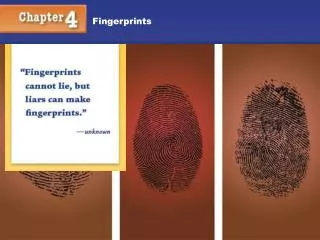
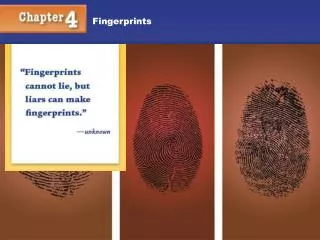
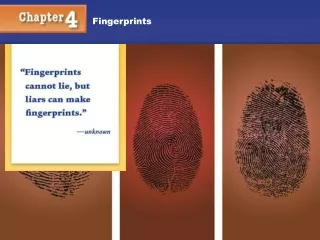
Fingerprints “Fingerprints cannot lie, but liars can make fingerprints” -Unknown
A little history… • First systematic attempt at personal identification devised by Bertillon in 1883 • Three parts: • Anthropometry • Portrait parlé • photographs
Bertillon card • 11 measurements • Detailed descriptions • Disease • Accidents • Deformities • Scars, tattoos, moles, warts, etc.
And elsewhere… • Evidence in early China • William Herschel (India) used handprints for legal documents
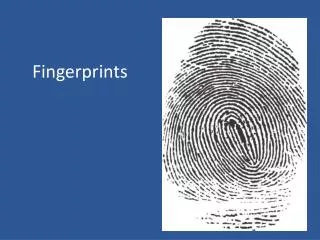
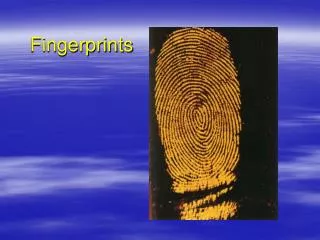
Why are they important? • It’s basically an impression of the pattern of ridges on the last joint of a person’s finger • They are so useful for ID because: • The ridges are unique and characteristic • They are consistent over a person’s lifetime • There is a systematic classification • Are humans the only ones? • Why do we have them?
Point 1 – they are unique • Individuality of a print is not determined by general shape or pattern, but in a careful study of the minutiae (the ridge characteristics)
Point 2 – they don’t change • Remember that skin is layers of cells • Nearest the surface – epidermis • Inner skin – dermis • Boundary of cells separating the dermis and epidermis – shape is made up of dermal papillae – that determines the form and pattern of the ridges • Each ridge populated by single row of pores that are openings for sweat glands – perspiration (along with oils) is transferred onto surfaces when touched
Point 3 – there’s a system • All fingerprints divided into three classes based on general pattern: • loops (60-65%) • whorls (30-35%) • arches (~5%)
In da loop • ulnar loop – ridges open towards pinky finger • radial loop – ridges open towards thumb • core – center of the pattern
Keep in mind which hand… Ulnar loop (on left, will flow out of right) Radial loop (on left hand, will flow out of the left)
Whorly-whorl • must have at least two deltas and a core • four types • plain • central pocket • double • accidental
Look closer… plain- two deltas with curving ridges central pocket – notice different deltas/different ridges
Look closer… double whorl accidental – follows whorl rules, but may include other pattern types
Golden arches? • simplest to spot • ridges enter one side and exit the opposite • plain arch – no upthrust in middle of print, ridges flow smoothly from one side to another • tented arch – has upthrust greater than 45 degrees in middle of print