Advanced Simulations and Properties of Ellipsoidal Dendrimers in Engineering Design
This document presents a comprehensive analysis of first principles simulations in the context of engineering design, focusing on the response and properties of ellipsoidal dendrimers. It covers finite element analysis, process simulation, and various transport properties. Key aspects include the flexibility of charge distributions, polarizability tensors, and methodologies for estimating solvent free energies. The enhancements in dendrimer performance through strategic orientation of chromophores and the statistical mechanical explanations of these improvements are discussed, alongside their implications in photonic materials.

Advanced Simulations and Properties of Ellipsoidal Dendrimers in Engineering Design
E N D
Presentation Transcript
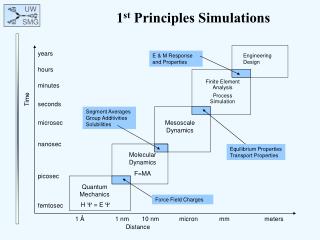
1st Principles Simulations E & M Response and Properties Engineering Design Finite Element Analysis Process Simulation Segment Averages Group Additivities Solubilities Mesoscale Dynamics Equilibrium Properties Transport Properties Molecular Dynamics F=MA Quantum Mechanics H = E Force Field Charges years hours minutes Time seconds microsec nanosec picosec femtosec 1 Å 1 nm 10 nm micron mm meters Distance
NLO Chromophre DMC3-97
Features of Ellipsoids • Complete flexibility of Charge and Dipole Distributions • Complete flexibility of Connectivity to other Ellipsoids • Complete flexibility of oreintation (for Monte Carlo and Brownian Dynamics Trajectories) • Polarizability Tensor • Computes all electrostatics with other Ellipsoids and arbitrary External Field • A contact function to find Ellipsoid-Ellipsoid interactions • Can have either Hard-Shell Repulsion or Leonard-Jones Interactions • Solvent free energies and exposure factors (use the rolling ball method) • Can generate dendrimers, polymers and lattices of ellipsoids
Dendrimer Performance By choosing a tilt angle for the three chromophores (~60°) the experimental enhancement (of ~ 2 fold) was realized. Statistical Mechanical Theory explains the improved performance of dendritic chromophores.