Innovating Enterprise Networks with GENI: Building Blocks for Enhanced Experimentation
The GENI initiative aims to revolutionize local enterprise networks by encouraging innovation beyond core backbones. By allowing production traffic and research experiments to coexist safely on shared hardware, we can create rich, complex network environments that yield immediate results for experimenters. Our phased approach includes developing the Enterprise GENI kit and deploying it across institutions. The use of OpenFlow technology enables centralized control and virtualization of networks while maintaining individual control for experimenters. This ensures stable and useful network deployments that benefit operators and researchers alike.

Innovating Enterprise Networks with GENI: Building Blocks for Enhanced Experimentation
E N D
Presentation Transcript
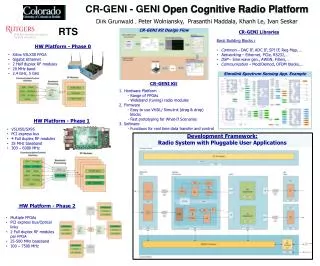
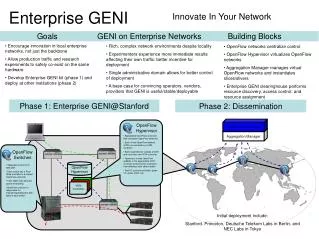
Innovate In Your Network Goals GENI on Enterprise Networks Building Blocks Enterprise GENI • Encourage innovation in local enterprise networks, not just the backbone • Allow production traffic and research experiments to safely co-exist on the same hardware • Develop Enterprise GENI kit (phase 1) and deploy at other institutions (phase 2) • Rich, complex network environments despite locality • Experimenters experience more immediate results affecting their own traffic: better incentive for deployment • Single administrative domain allows for better control of deployment • A base-case for convincing operators, vendors, providers that GENI is useful/stable/deployable • OpenFlow networks centralize control • OpenFlow Hypervisor virtualizes OpenFlow networks • Aggregation Manager manages virtual OpenFlow networks and instantiates slices/slivers • Enterprise GENI clearinghouse performs resource discovery, access control, and resource assignment Phase 1: Enterprise GENI@Stanford Phase 2: Dissemination GENI Clearing House OpenFlow Hypervisor Aggregation Manager • Specialized OpenFlow controller that virtualizes OpenFlow networks • Each virtual OpenFlow network (VON) is controlled by a VON controller • Each experimenter creates a VON and runs their own VON controller • Hypervisor routes OpenFlow updates to the appropriate VON controller and prevents controllers from affecting each other’s traffic • Red VC controls red traffic, green VC, green traffic, etc. OpenFlow Switches OpenFlow Hypervisor • Separates control from data path • Each switch has a Flow Table and talks to a shared OpenFlow controller • Flow Table entry decides packet forwarding • OpenFlow controller is responsible for maintaining/editing the flow table of each switch VON Controller Initial deployment include: Stanford, Princeton, Deutsche Telekom Labs in Berlin, and NEC Labs in Tokyo