Download
1 / 17
170 likes | 288 Vues
In this presentation, Gil Shwed, Chairman and CEO of Check Point, discusses the evolution of IT start-ups and the core principles of building successful businesses. He emphasizes creating customer value through innovative products and understanding market needs. Shwed outlines the advantages of lean operations and agile innovation. Drawing from the Check Point case study, he illustrates the journey from a small start-up in a garage to a world-class company, highlighting the importance of focusing on sales, technology, and strategic investment for sustainable growth.

E N D
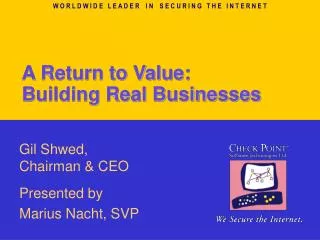
A Return to Value: Building Real Businesses Gil Shwed, Chairman & CEO Presented by Marius Nacht, SVP
Agenda • Evolution of the IT Start-Up • Goals • Fundamentals • Creating value • The Check Point Case • Market and technology growth • Financial results • Creating customer value
The Tech Start-up:The Opportunity • Innovation and low cost of entry • Significant entrepreneurial opportunity • The Entrepreneur • Innovate & Make a difference • Be A Leader • Achieve Financial Success
How Is This Achieved? • Customer Need • Products/Services that fills a real need • Customers are willing to pay for this • The Start-up Advantage • Focused & Creative • Expertise – Market & Technology • Fast & Flexible Innovation
The Start-Up’s Plan: Pre-1995 • Created an Innovative Product, Technology or Service • Lean (2-4 people) “garage operation” • Spent cautiously and operated on limited resources • Found the Early Adopters • Made “real world” products • Started selling! • Built a company • Grew sales first, then grew company • Evolved the technology just ahead of market
The Start-Up’s Plan: 1998 - 2000 Identified a HUGE Opportunity (or jumped on a “hot” bandwagon) • Hoped for big money rewards • Challenge was to gain mindshare Created Mindshare • Spent $$$ (before a real product) • Built a company that fit a HUGE opportunity Focused on internal growth • Built a big company prior to proven market/product RESULT: You’ve just lost your start-up advantages • Not as fast, focused or cost effective
What does the Plan for a Post-2001 Start-Up Look Like? A Pre-1995 Start Up Plan…
The Start-Up’s Plan: Pre-1995 The Start-Up’s Plan: Post-2001A Return to Value • Create an Innovative Product, Technology or Service • Lean (2-4 people) “garage operation” • Spend cautiously; operate on limited resources • Find the Early Adopters • Make “real world” products • Start selling! • Build a company • Grow sales first, then grow company • Evolve the technology just ahead of market • Created an Innovative Product, Technology or Service • Lean (2-4 people) “garage operation” • Spent cautiously; operate on limited resources • Found the Early Adopters • Made “real world” products • Started selling! • Built a company • Grew sales first, then grew company • Evolved the technology just ahead of market
A Return to Value:Focus & Efficiency • Sales • Customers/Partners • Technology Efficient – Invest in the right places
Check Point Case: From Start-Up to World Class Company • 1993 – 1994: Launching Company • The Israeli version of a “garage operation”: • Headquarters = Grandmother’s apartment • Staff = 3 Founders (3 Developers added towards end of 1994) • Undercover development • Guerilla Marketing • 1995 – 2001: Building a World-Class Company • Worldwide Operations – Sales & Services • From $10M to $0.5B Sales • Global Organization • 300 R&D, 300 Sales, 200 Services
1999 1997 1994 VPN Firewalls • End-to-end Internet security platform • Desktop/Client security • eBusiness application security Check Point Case:Setting Technology Standards 2001 • Stateful Inspection • First shrink-wrapped firewall • Integrated • VPN/Firewall • OPSEC • Alliance • Gigabit Performance • VPN Enterprise Scalability • Security Dashboard
Net Income Revenues EPS Creating Value:Check Point Revenues & Profits $1.20 $ 600 $ 500 $0.80 $ 400 Millions $ 300 $0.40 $ 200 $ 100 $0.00 $ 1995 1996 1997 1998 1999 2000 12 Month
When starting – try to find • “Exploding” Markets • Hard to predict • Enough for many • Partner • Can’t do it all (and well) • Innovation • Technology • Utilization • Marketing
Summary • “Economic Value” is back • Companies are measured on revenues and earnings • Grow only as much as you can afford / as much as is financially justified • “Start-up and Innovation” culture is back (“Get rich fast” might not work that well)
How Is This Achieved? • Customer Need • Products/Services that fills a real need • Customers are willing to pay for this • The Start-up Advantage • Focused & Creative • Expertise – Market & Technology • Fast & Flexible Innovation