Download
1 / 22
220 likes | 331 Vues
This presentation from the FDA/Industry Workshop (Washington, DC, September 16, 2005) outlines essential strategies for integrating patient-reported outcomes (PRO) into clinical development programs. Key topics addressed include the selection and validation of PRO instruments, their role in measuring treatment effects from the patient's perspective, and the significance of clinically meaningful differences. The importance of documentation, trial design, and adherence to regulatory guidelines is emphasized, aiming to ensure that labeling claims are supported by reliable and valid evidence.

E N D
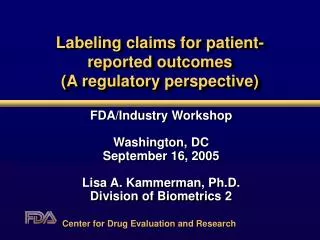
Labeling claims for patient-reported outcomes(A regulatory perspective) FDA/Industry Workshop Washington, DC September 16, 2005 Lisa A. Kammerman, Ph.D. Division of Biometrics 2 Center for Drug Evaluation and Research
Disclaimer Views expressed in this presentation are those of the speaker and not, necessarily, of the Food and Drug Administration.
Introduction • Start early in development program • Instrument selection • Role of outcome in clinical study • Issues to address • Development and validation • Clinically meaningful difference • Implementation
Introduction • Trial Design • Conduct of clinical study • FDA review • Instrument • Study results • And then …. Labeling Claims
To support a PRO claim • Reliable and valid instrument • Instrument measures concepts claimed • Instrument measures impact of an intervention • Well-controlled investigations
Early in product development • Identify endpoints • Identify desired claims • Discuss with FDA
Selection of PRO Instrument • Measures the claimed treatment benefit from the patient’s perspective • Measures both the positive and negative benefits of the intervention
Selection of PRO Instrument • Specific to the intended population • Specific to the characteristics of the conditions or disease treated
Selection of PRO Instrument • Three possible choices • Existing instrument • Modification of existing instrument • New instrument
Document, document, document! • Development of instrument • Patient involvement • Population • Goals • Validation of instrument • Format, wording • Cultural issues, multinational studies • Drug intervention studies
Document, document, document! • Concepts: what will be measuredExamples: • Pain severity • Psychological function • Physical function
Document, document, document! • Domain: Q conceptExamples: • PFSF: Desire, Responsiveness, Disinterest • Physical function: symptom improvement, physical abilities, ADL
Document, document, document! • Clinically meaningful difference • Prospective plan • Patient involvement • Planned use in clinical study • Primary evidence for efficacy • “Value-added” • Intended population
Document, document, document! • Implementation • Training and instructions • Format
Trial Design Issues • Prospectively defined • Blinding • Use of instrument • Standardized instructions • Standardized training • Training and blinding of interviewers • Recall to baseline
Trial Design Issues • Data capture • Paper • Electronic
Role of PRO as an endpoint • Primary evidence of efficacy • “Value-added” • Pre-specify • Report findings, regardless of statistical significance and direction
Analysis Plan • Missing data • Entire instruments • Domains • Items • Visits • Multiple endpoints
And finally … Labeling! • Well-controlled studies • Instrument reliably and validly measures the concepts claimed • Convey both positive and negative effects • Specific to the concept measured
Summary • Start early in clinical development program • Talk to FDA review divisions • Document, document, document • Development of instrument • Validation of instrument • Clinically meaningful difference • Implementation
Summary • Study Design • Blinding • Use of instrument • Prospectively defined • Analysis plan
Summary • Labeling • Conveys both negative and positive effects • Specificity to concepts measured