Genetic Engineering
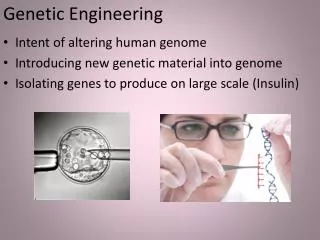
Genetic engineering involves connecting DNA fragments from different sources to create transgenic organisms, which are plants or animals modified with foreign genes. Key applications include creating insulin through bacteria and developing crops with enhanced traits, such as tomatoes with antifreeze proteins from Arctic fish. Techniques like gene splicing help insert specific genes, while gene therapy aims to correct genetic disorders. Selective breeding, hybridization, and cloning further illustrate genetic manipulation's breadth in modern science.

Genetic Engineering
E N D
Presentation Transcript
Recombinant DNA Technology • Connecting fragments of DNA from different sources
Transgenic Organisms • Plants and animals that contain fragments of DNA from different sources. • Example: tobacco plant with firefly gene that makes the plant glow
Bacteria and Recombinant DNA Technology • Scientists commonly use bacteria to produce substances like human insulin or human growth hormone • They all use bacteria because they reproduce asexually and reproduce rapidly
Creating Bacteria with Human Genes (DNA) – Step 1 • Cut a piece of DNA that codes for a specific gene using restriction enzymes (act like scissors). They cut DNA at a specific nucleotide sequence. • Example:
Step 2 • Cut plasmid (small circular DNA found in bacteria) with restriction enzymes.
Step 3 • Gene splicing: Foreign DNA is attached to the plasmid creating recombinant DNA. • The recombinant DNA is inserted into the bacteria. The bacteria will reproduce asexually.
Animation • http://www.youtube.com/watch?v=x2jUMG2E-ic • http://www.dnai.org/text/mediashowcase/index2.html?id=549
What do scientists use this for? • To produce insulin, human growth hormone, enzymes to break down pollutants, produce natural insecticides, etc.
What would arctic fish have to do with making the perfect tomato?
Transgenic Plants • Genetically engineered plants with recombinant DNA. • Example – tomato with the antifreeze gene from fish
Transgenic Animals • Genetically engineered animals with recombinant DNA. • Ex – Creating animals with human organs for transplants
Gene Therapy • Inserting normal genes into human cells to correct genetic disorders
Selective Breeding • Choosing animals and plants to mate with desirable traits. • Ex – Texas cattle and Brahman cattle
Hybridization • Mating individuals not closely related to introduce new beneficial genes into a population • Ex – Horse (obedient) + donkey (strong) = mule (obedient and strong)
Inbreeding Mating between closely related individuals to maintain desirable traits.
Choosing a Mutation • Seedless oranges, ancon sheep (short legged). We choose to breed mutations for our benefit.
Cloning • Creating identical individuals with the desired traits. • Ex – Dolly the sheep, vegetative propagation, etc.