Energy Conversion in Living Organisms: Photosynthesis and Respiration
200 likes | 301 Vues
Learn how sunlight is converted to energy in photosynthesis, and how organisms generate ATP through cellular respiration. Understand the stages, processes, and factors affecting these vital metabolic pathways.


Energy Conversion in Living Organisms: Photosynthesis and Respiration
E N D
Presentation Transcript
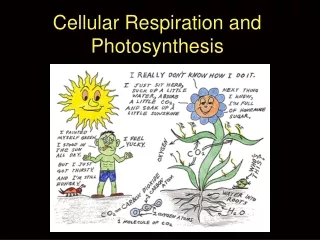
Section 5-1 • Directly/indirectly, almost all energy in LTs needed for metabolism comes from the sun.
Section 5-1 • Building Molecules that Store Energy: • Photosynthesis: process by which light energy is converted to chemical energy. • Autotrophs: • Organisms that use energy from sunlight or from chemical bonds in inorganic substances to make organic compounds; plants, bacteria
Section 5-1 • Heterotrophs: • Organisms that must get energy from food instead of from sunlight/inorganic substances • Cellular respiration: • Metabolic process in which consumed food energy is converted to ATP energy Most fungi Most bacteria Most protozoa All animals
Section 5-1 • Transfer of Energy to ATP: • When cells break down food molecules, some energy is released as heat. Most remaining energy is stored in ATP • Like money, ATP is a portable form of energy “currency” in cells and is delivered wherever it is needed in the cell ATP ATP
Section 5-1 • ATP (adenosine triphosphate): • nucleotide w/ 2 extra energy-storing phosphate groups • Energy is released when bonds holding phosphate groups together are broken • Removal of phosphate group from ATP produces adenosine diphosphate, ADP
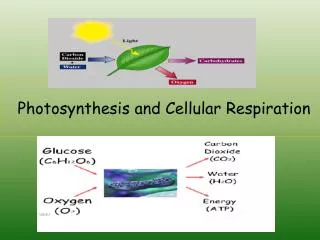
Section 5-2 • Stages of Photosynthesis: • Stage 1 Energy captured from sunlight • Stage 2 Light energy converted to ATP and energy carrier NADPH • Stage 3 Using CO2 and energy stored in ATP and NADPH powers the formation of organic compounds • 6CO2 +6H2O C6H12O6 +6O2
Section 5-2 • Stage 1: Capture Light Energy/O2 released • Pigments: • Contain light-absorbing substances • Chlorophyll: • Main pigment involved in photosynthesis, absorbs mostly blue/red light, reflects green/yellow light • Plants contain 2 types of chlorophyll, chlorophylla and b • more…
Section 5-2 • Carotenoids: • Pigments that produce yellow/orange fall leaf colors, fruits, vegetables, flowers • Carotenoids absorb different wavelengths from chlorophyll, so having both pigments enables plants to absorb more light energy during photosynthesis • more…
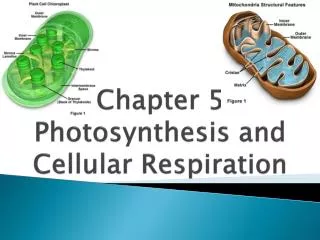
Section 5-2 • Stage 1: Capture Light Energy/O2 released • Thylakoids: • Clusters of pigments embedded in mem of disk-shaped structures • Light strikes thylakoid, energy is transferred to e- in chlorophyll • Causes e- to jump to higher energy level • e- are replaced by splitting water and O2 is released
Section 5-2 • Stage 2: Convert Light Energy to ATP/NADPH • Excited e- leave chlorophyll to make ATP/NADPH that temporarily store energy • 1st excited e- jumps to nearby molecule in thylakoid membrane; e- is passed through series of molecules along thylakoid membrane, electron transport chain (ETC) and ATP/NADPH are made
Section 5-2 • Stage 3: Store Energy in Organic Compounds • Carbon dioxide fixation: • C atoms from atmospheric CO2 are used to store chemical energy in organic compounds • Calvin cycle: • series of enzyme-assisted rxn produces organic compounds
Section 5-2 • Factors that Affect Photosynthesis: • Photosynthesis ↑ as light intensity ↑ until all pigments are being used • Photosynthesis is most efficient w/in certain temperature range
Section 5-3 • O2 makes production of ATP more efficient, although some ATP is made w/o O2 • Aerobic: • Metabolic processes that need O2 • Anaerobic: • Metabolic processes that don’t need O2
Section 5-3 • 2 Stages of Cellular Respiration: • Stage 1: • Glucose converted to pyruvate, makes small amt of ATP/NADH • Stage 2: • O2 present, pyruvate/NADH used to make large amt of ATP via ETC • O2 not present, pyruvate converted to either lactate or ethanol/CO2
Section 5-3 • Stage 1: Breakdown of Glucose/Glycolysis • Glycolysis: • 1st stage of cellular respiration, glucose is broken down in cytoplasm • As glucose is broken down, some of its H atoms are transferred to an e- acceptor called NAD+ to form an e- carrier NADH • Some ATP, NADH, 2 pyruvates result
Section 5-3 • Stage 2: Production of ATP • O2 is present, pyruvate enters mitochondria and is converted to 2-C compd • This rxn produces 1 CO2 molecule, 1 NADH molecule, and 1, 2-C acetyl group • Acetyl group is attached to coenzyme A (CoA), forming acetyl-CoA that enters the Krebs Cycle • more…
Section 5-3 Stage 2: Production of ATP via Krebs Cycle Krebs cycle: series of rxns in the mitochondria where 6 NADH, 2 FADH2, and 2 ATP are made more…
Section 5-3 • Stage 2: Production of ATP via ETC • In aerobic respiration, e- donated by NADH and FADH2 pass through ETC • In eukaryotic cells, ETC is located in inner membranes of mitochondria • At end of ETC, H+ ions and e- combine w/ O molecules forming H2O • 34ATP made • via ETC
Section 5-3 • Respiration w/o Oxygen is Fermentation • When O2is present, aerobic respiration occurs to produce ATP • When O2isn’t present, fermentation occurs producing lactic acid in animals or in plants alcohol/CO2