
Realism
E N D
Presentation Transcript
Realism definitions • “A term first used in France in the 1850s to characterize works concerned with representing the world as it is rather than as it ought to be.” [source: Cambridge Guide to Literature in English] • “Realism was first used as a literary term in France, where it was applied to literary and visual forms which aim for the accurate reproduction of the world as it is.” [source: Bloomsbury Dictionary of the English Language]
the world as it is • tries to “document” contemporary life • use of “every day” scenes • tends to create objective depictions • often involves characters from the lower classes • historically, the poor had not been the subject of novels • Writers (e.g., Balzac and Flaubert) were accused of immorality. Their defense was often that they were “realists”. [sources: Cambridge Guide & Bloomsbury Dictionary]
Realist Writers • Gustave Flaubert (1821-1880) • Madame Bovary (1856) • Sentimental Education (1869) • Leo Tolstoy (1828-1910) • War and Peace (1869) • Anna Karenina (1873-1877) • Fyodor Dostoevsky (1821-1881) • Crime and Punishment (1866)
In Art+ Gustave Courbet was the first artist to proclaim and practice the realist aesthetic. [source: Britannica Concise Ency.]Burial at Ornans (1849-1850)
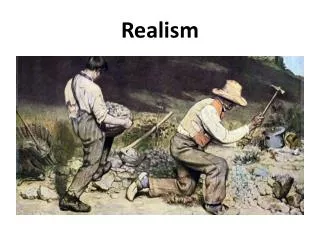
GUSTAVE COURBET, The Stone Breakers, 1849. Oil on canvas, 5’ 3” x 8’ 6”. Formerly at Gemäldegalerie, Dresden (destroyed in 1945).
Gustave Courbet and Realism[source: Gardner’s Art Through the Ages, p. 733] • Realists provide “the viewers with a reevaluation of ‘reality’.” • Only things of one’s own time are “real”. • Focus on, and depiction of, experiences of everyday, contemporary life • disapproved of traditional fictional subjects • they are not “real”, not of the present word • Courbert: “show me an angel, and I’ll paint one.”
Academic vs. Realist artnudity of mythological characters was acceptable, the nudity of a “shameless” woman was not William Bouguereau’s Nymphs and Satyr in Academic Style Manet’s Olympia
Sometimes there is a message. It may be political or critical of society. HONORÉ DAUMIER, The Third-Class Carriage, ca. 1862. “… provides a glimpse into the cramped and grimy railway carriage of the 1860s. The riders are poor and can afford only third-class tickets. … [they] were crammed together on hard benches that filled the carriage.” [source: Gardner’s Art Through the Ages, p. 737]