
NAIC Risk-Based Capital
E N D
Presentation Transcript
NAIC Risk-Based Capital Walter Bell NAIC President and Alabama Insurance Commissioner Vice Chair of IAIS Executive Committee ASSAL ANNUAL CONFERENCE Santiago, Chile
History of Risk Based Capital • Risk based capital concept began in 1989 • September 1990, Examination Oversight Task Force of NAIC determined Risk Based Capital requirements were preferable to minimum capital and surplus requirements • December 1990, NAIC formed two RBC working groups (one life and one property and casualty)
History of Risk Based Capital (Continued) • 1991 and 1992 Risk-Based Capital survey distributed to companies • Life RBC formula finalized in 1993 • P/C RBC formula finalized in 1994 • RBC standards for health organizations were implemented in 1998
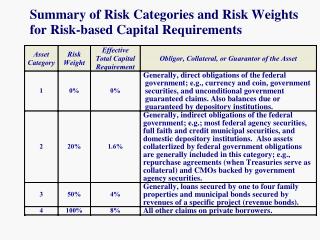
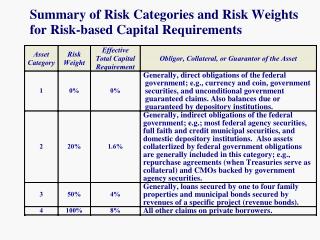
History of Risk Based Capital (Continued) • The NAIC RBC formula is generally a formula-based calculation of a minimum level of capital • Total Adjusted Capital is compared to 4 action levels of RBC where action is taken by the company or the regulator:
History of Risk Based Capital (Continued) • RBC Action Levels: • Company Action Level • Regulatory Action Level • Authorized Control Level • Mandatory Control Level
History of Risk Based Capital (Continued) • The number of companies at action levels has remained relatively constant for life and property/casualty (non-life) RBC since inception:
History of Risk Based Capital (Continued) • As a result of P/C insolvencies in the early 2000’s, a ‘trend test’ was added to P/C RBC in 2005 • The ‘trend test’ may trigger a company action level if a ratio of the companies claims and expenses to premiums is unfavorable
History of Risk Based Capital (Continued) • The number of health companies at action levels started high and has declined subsequently:
Principles-Based CapitalProperty and Casualty RBC • Catastrophe Risk • Potentially use modeling of catastrophe risk in the RBC formula • Allow companies to use their own RMS, Equecat, etc. models
Principles-Based CapitalLife RBC • C-3 – Interest Rate Risk and Market Risk • C-3 Phase I – 2000 • C-3 Phase II – 2005 • C-3 Phase III – 2008 or 2009 • C-3 Phase IV • Future ?
C-3 Phase I • Interest rate risk of annuities and single premium life • Based on cash flow testing of assets and liabilities • Originally, only companies that triggered one of two tests for materiality • May be changed to a CTE methodology for modeling in the future.
C-3 Phase II • Interest rate risk and market risk of annuities with guaranteed benefits • VAGLB (Variable Annuity with Guaranteed Living Benefits) • GMIB (Guaranteed Minimum Income Benefit) • GMDB (Guaranteed Minimum Death Benefit) • Modeling using a CTE approach • Relatively small number of companies
C-3 Phase III • Interest rate risk and market risk for life products • Modeling using a CTE approach • Affect a large number of companies
C-3 Phase IV • Interest rate risk for all annuities • Modeling using a CTE approach • Replace current C-3 Phase I and perhaps Phase II
Future • Combine C-3 Phases into one ? • Asset Risk ? • Insurance Risk ? • Comprehensive internal models ?
Future (Continued) • NAIC Overarching Consideration: • Capital standards and compliance measurements should be firmly rooted in an auditing, accounting, and actuarial context that is cost-justified, practical, and workable. • Especially, when regarding an adversarial regulatory action that must proceed based on legal findings.
THANK YOU Walter Bell NAIC President and Alabama Insurance Commissioner Vice Chair of IAIS Executive Committee Walter.Bell@insurance.alabama.gov