Download
1 / 4
40 likes | 153 Vues
Successful business plan implementation requires a clear understanding of potential constraints, both positive and negative. It is crucial to monitor performance effectively, knowing who will record the information and when it will be captured. Specify desired comparisons, ideally using acceptable ranges instead of fixed benchmarks. Responses to findings can be feedback-focused for future improvements or concurrent for immediate problem resolution, like leveraging contract labor. Documentation is essential; summarize your strategies for addressing constraints to ensure clarity and adaptability in your plan.

E N D
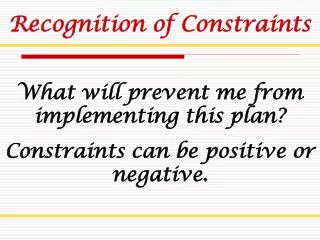
Recognition of Constraints What will prevent me from implementing this plan? Constraints can be positive or negative.
Monitor the Plan a. Know who, when, and how the information about the business’s performance will be recorded. b. Specify the comparisons you would like to be made. It is best to set a range which is acceptable rather than one value as a benchmark.
Monitor the Plan(cont.) c. Type of response. Feedback response focuses on the improvement in the future and involves using the information collected. Concurrent response focuses on immediately solving the problem. Using contract labor is an example of a concurrent response.
Document, Share, and Revise Written documentation of how the owner plans to meet that goal. This may be a summary.