Meningitis
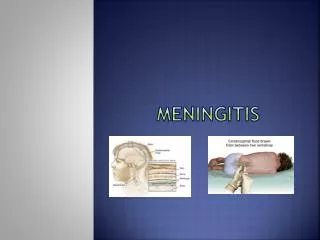
Meningitis. By : Sarah Gobbell. What is it?. Meningitis is the inflammation of the meninges, the membranes that cover the brain and spinal cord. Causes. Meningitis can be either bacterial or viral (aseptic).


Meningitis
E N D
Presentation Transcript
Meningitis By : Sarah Gobbell
What is it? • Meningitis is the inflammation of the meninges, the membranes that cover the brain and spinal cord.
Causes.... • Meningitis can be either bacterial or viral (aseptic). • Usually caused by the spreading of infection or virus from one part of the body to another. • Common starting points of infection are: • Skin • Gastrointestinal • Urinary System • And most common, the Respiratory System
Causes Cont'd • Once the infection spreads, it enters the blood stream and travels to the CNS. • Some meds, cancers, and even other diseases can lead to the inflammation of the meninges. • Other causes include: • Bacterial Ear Infection • Nasal Sinus Infection • Severe Head Trauma/ Surgery
Viral vs Bacterial • Viral Meningitis • Viral is most common • Often goes undiagnosed because syptoms are like that of the common flu • More common in the Summer and Fall • Usually caused by enteroviruses (stomach flu)
Virus vs Bacterial • Bacterial • More common in infants and adults >60 years • If not diagnosed and treated quickly, bacterial meningitis can lead to: • Hearing Loss • Visual Impairment • Seizures • Learning Diabilities • Heart, Kidney, and Adrenal Problems
Signs and Symptoms In Adults
Signs and Symptoms In Infants
Signs and Symptoms • Kernig’s Sign- The inability to extend the legs completely without extreme pain. • Brudzinski’s Sign- Flexion of the hip and knee when the neck is flexed.
Diagnostics • A pt History will be taken • Physical exam to reveal Kernig’s sign or Brudzinski’s sign • Lumbar puncture ( spinal tap) to identify the pathogenic organism • CT/ EEG • Post recovery hearing • exam
Medical Management • For bacterial meningitis, the pt is hospitalized and given IV antibiotics until the organism is identified. • Ampicillin, penicillin, and third generation cephalosporin ( for inflammation) • Anticonvulsants may be used to prevent seizures • Hyperosmolar agents or steroids to decrease intracranial pressure
Most at Risk • Infants and adults > 60 years • Compromised immune system • People in boarding schools, military bases, college students, etc. (around large groups of people) • Not current in vaccines such as: • Measles • Mumps • Rubella • Polio • Hib • Pneumococcus
Interventions • Respiratory isloation until pt can no longer be cultured from the nasopharynx, 24 hours after antibiotic therapy • Increase fluids • Darkened room • Minimize sensory stimulation • For viral meningitis, the pt can usually go home. Over the counter pain killers such as acetaminophen ( Tylenol), or ibuprofen (Advil/ Motrin) will be suggested