Updates on NASA Technical Standards: Handbook Development and SLaTS Coordination
50 likes | 177 Vues
This document outlines the tasks and deliverables related to NASA's Technical Standards updates for the Handbook (HB) and the Space Launch and Transportation Systems (SLaTS). It details progress on sections concerning Wind, Lightning, and Radiation, including draft submissions and ongoing research efforts. Funding status and issues are addressed, as well as the schedule for future milestones and coordination meetings. The document serves as a summary of accomplishments, plans for further updates, and the collaboration required to meet technical goals.
Updates on NASA Technical Standards: Handbook Development and SLaTS Coordination

E N D
Presentation Transcript
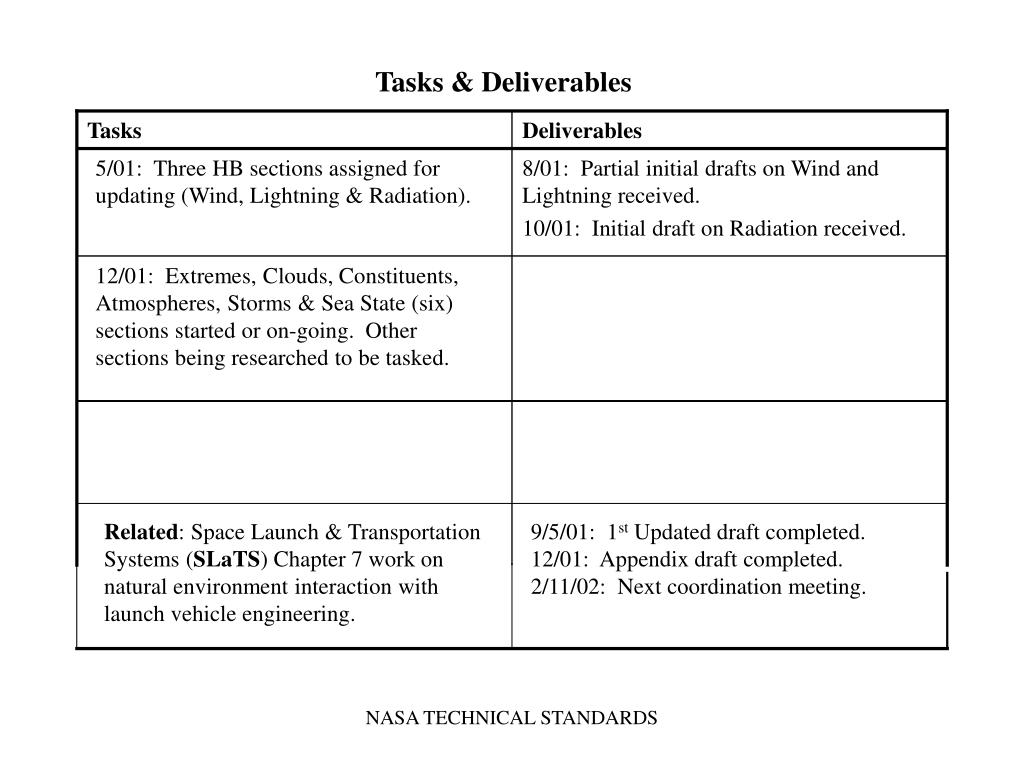
Tasks & Deliverables Tasks Deliverables 5/01: Three HB sections assigned for updating (Wind, Lightning & Radiation). 8/01: Partial initial drafts on Wind and Lightning received. 10/01: Initial draft on Radiation received. 12/01: Extremes, Clouds, Constituents, Atmospheres, Storms & Sea State (six) sections started or on-going. Other sections being researched to be tasked. Related: Space Launch & Transportation Systems (SLaTS) Chapter 7 work on natural environment interaction with launch vehicle engineering. 9/5/01: 1st Updated draft completed. 12/01: Appendix draft completed.2/11/02: Next coordination meeting. NASA TECHNICAL STANDARDS
Status • Status (R|Y|G|TBD|N/A) • Cost=G • Schedule=G • Technical=G • Customer satisfaction=TBD • Issues & Resolutions • Issue: Need $60K in FY02 (in USRA Task Agreement) to stay on schedule in the update and review of Standards Terrestrial Handbook. • Resolution: To be determined by availability of resources. • $10K (CSC) & $9K 2nd Gen (USRA) funds obtained and applied. • $12K (Standards) and $10K (FY02 Institutional) funding pending. • $29K short. Will look to SLI, 2nd Gen and Shuttle. • Comments • None NASA TECHNICAL STANDARDS
Schedule • Milestones • Standards HB Update: • 2/01-1/02: Literature search for state-of-the-art technology on HB sections. • 8/01-10/01: Winds (CSC), Thermal Radiation (CSC), & Atmospheric Electricity (SD) 1st initial Section drafts delivered. • 12/01: Thermal Radiation review started. • 3/02: Winds and Electricity sectional drafts to be completed. • 08/02: Extremes, Clouds, Constituents, Atmospheres, Storms & Sea State sections started. Drafts anticipated completion by 08/02. • SLaTS: • 01/01-01/02: [SLaTS] Related - Space Launch and Transportation Systems (SLATS) work, involving book chapter #7 by ED44. • 02/28/01: Initial SLaTS draft submitted. • 08/16/01: Red-lined corrections sent back. • 09/05/01: Authors meeting and presentation at MSFC. • 12/01: SLaTS Appendix A revised. • 02/02: Work continuing on chapter 7 document for 02/02 meeting. NASA TECHNICAL STANDARDS
Accomplishments & Plans • January Accomplishments • Standards HB Update: • Further literature searching continued on HB sections, for update purposes. • $12K Standards Program & $10K Institutional funding indicated. • Earlier: Draft Sections Received: Partial draft: Wind (CSC/Adelfang) and Lightning (SD/Koshak). Complete draft: Radiation (CSC/Justus). • Lightning and Wind section work continuing via Ratheon (Leahy) & CSC (Smith). Work progressing in 6 other sections (Clouds, Extremes, Constituents, Atmospheric Models, Storms & Sea State). • Radiation section internal review started. • SLaTS: • SLaTS chapter 7 work resumed, after 9/5/01 SLaTS symposium. • SLaTS Appendix A revised. NASA TECHNICAL STANDARDS
Accomplishments & Plans • Plans • - Standards HB Update: • Continue literature research, establish section involvement, obtain needed models/documents/etc for HB update. • Seek potential funding - needed for HB technical update & review. • Continue in determining which personnel, software, databases, etc will be needed and involved in the update of various HB sections. • Lightning & Wind section initial complete drafts due in 03/02. • Radiation section review to finish. • - SLaTS: • Continue to work SLaTS chapter 7 document for 02/02 SLaTS coordination meeting. NASA TECHNICAL STANDARDS