Exploring the Standard of Ur: An Archaeological Webquest
90 likes | 194 Vues
This webquest guides students through the archaeological significance of the Standard of Ur. Participants will follow detailed instructions across six parts, including predictions about the meaning of "Standard," background on the ancient city of Ur, a biography of the archaeologist Leonard Woolley, his notable discoveries, an exploration of the Royal Tombs of Ur, and a detailed examination of the Standard itself. Students will utilize provided resources, avoiding cut-and-paste methods, and will conclude with a bibliography of sources.


Exploring the Standard of Ur: An Archaeological Webquest
E N D
Presentation Transcript
The Standard of Ur Archaeological Webquest
Instructions • Carefully follow the instructions on each individual slide • Answer the questions that accompany each of following 6 parts of this assignment • Links are provided to help answer questions • Do not cut and paste • Provide a total list of website used at the end
Part I: PredictionAnswer both questions with complete sentences • What meanings can “Standard” have? • What do you think was meant by “Standard of Ur?” • Use the links below to help you develop an answer. No copy and pasting! • Link #1 • Link #2
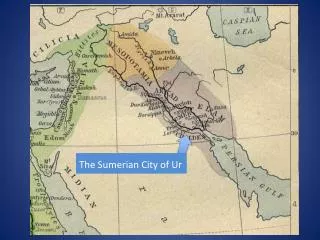
Part II: BackgroundAnswer with a paragraph. Cite your sources. No Wikipedia or about.com • What was Ur? • A hint…
Part III: The Archaeologist • Write a short, point-form biography on Leonard Woolley. • Must be at least ten points • Info must come only from sources below • Source #1 • Source #2
Part IV: Discoveries • In general, what were some of Leonard Woolley’s most significant discoveries at Ur? • Answer in point form, 4 points • Link #1
Part V: Exploration • Use the “Explore” link on the ‘Royal Tombs of Ur’ page and explore the different facets of the tombs. • Can you find the Standard of Ur? • In a detailed, well written paragraph: • Describe where the “Standard of Ur” was found • Describe what the “Standard of Ur? was? • Describe why Woolley called it the “Standard of Ur”
Part VI: Examination • The Standard of Ur • Look closely at both sides of the Standard. • What is depicted? • What technologies are seen? • How do the two sides differ? • What does this tell us about Sumerian people? • Discuss some of the depictions that stand out make an educated guess about their meaning. • Answer with 3-4 well written paragraphs, include intro & conclusion