Enhancing Water Supply Services in Small Towns: Pro-Poor Regulation Lessons from Chad, Mali, and Niger
90 likes | 200 Vues
This report explores pro-poor regulation mechanisms for water supply services in small towns throughout Chad, Mali, and Niger. It highlights challenges such as low household incomes, limited service coverage, and community management issues. The role of third-party auditors in improving efficiency and reliability, along with strategies for enhancing transparency, benchmarking performance, and ensuring water quality, are discussed. Key lessons aim to foster better negotiations between local governments and providers, engage consumers, and promote competition in water service delivery.


Enhancing Water Supply Services in Small Towns: Pro-Poor Regulation Lessons from Chad, Mali, and Niger
E N D
Presentation Transcript
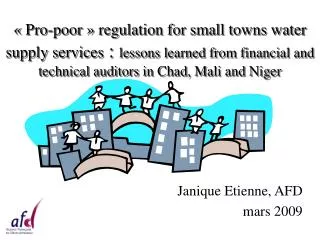
« Pro-poor » regulation for small towns water supply services : lessons learned from financial and technical auditors in Chad, Mali and Niger Janique Etienne, AFD mars 2009
« Pro-poor » regulation for small towns water supply services : lessons learned from Chad, Mali and Niger experiences • Regulatory mechanism to ensure efficient and reliable service provision for small towns • Context • Household revenus are around 3 $/day • Low coverage - Service level is predominantly standposts • Higher Tariffs : no cross-subsidy between towns and between consumers • Community managed systems : « volunteer » managers are often inefficient and ineffective • Lack tranparency
« Pro-poor » regulation for small towns water supply services : lessons learned from Chad, Mali and Niger • Set up • Water authority designates a third party as auditor • A number of municipal councils sign an agreement with this third party to conduct technical and financial audits • Role • Technical and financial data collection • Small providers support (users associations or SSIPs) • Water quality testing • Financial audit • Reporting to a general assembly of users
Ministry Mandate Water authority Local government Agreement Delegatedmanagementcontract Auditor NGO, consultant, Lmt Co Provider Associations or entrepreneurs Support and control users
« Pro-poor » regulation for small towns water supply services : lessons learned from Chad, Mali and Niger • Observation • Misappropriation of funds by providers • High commercial and technical losses • Unpaid water bills by government services (136 MEuros in Mali -2006-) • Results • Improve transparency through reporting, • Improve performance via benchmarking • Ensure water quality through technical audit
« Pro-poor » regulation for small towns water supply services Auditor CCAGMoundouTCHAD BCCMaradi NIGER GCS-AEPMALI Revenues 20 to 40 FCFA/m3 35 000 € 17 500 € 76 000 € Nb of users(Nb of centres) 265 000(30) 150 000(20) 450 000(59) Water revenus (Providers) 900 000 € 450 000 € 2 500 000 € Asset value 14 M€ 8 M€ + 20 M€
« Pro-poor » regulation for small towns water supply services : raises questions for scaling up • Extend such mechanisms ?... To strengthen : • Négociations between local governments and water providers • Feedback to consumers (through general assembly of consumers) • Competition to increase transparency • Monitoring of water quality (compliance)