Conservative Forces and Potentials
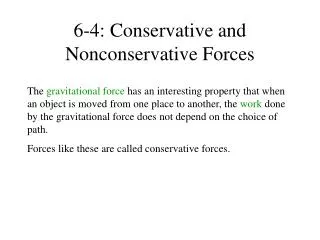
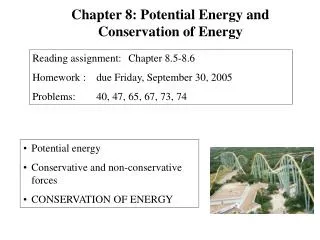
Explore the nature of conservative forces and their relationship with potential energy functions. Every conservative force can be represented as the spatial derivative of a potential energy function, expressed mathematically as F = -∇U. This understanding reveals the behavior of systems in equilibrium, differentiating between stable and unstable equilibria. The chapter discusses essential concepts including Hooke’s law, energy diagrams, and potential wells. Key topics also include the characterization of neutral equilibrium and how potential energy affects particle motion in various conditions.

Conservative Forces and Potentials
E N D
Presentation Transcript
Conservative Forces and Potentials Which forces are conservative? § 7.4
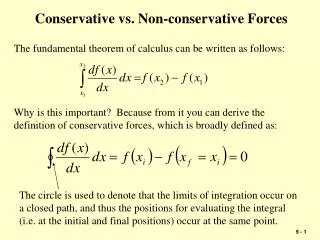
Forces and potentials Every conservative force is a spatial derivative of a potential energy function. Specifically, F = –(idU/dx + jdU/dy + kdU/dz) (This is Calculus 3 stuff)
Forces and potentials Every conservative force is a spatial derivative of a potential energy function. • Near-surface gravity: Source: Young and Freedman, Figure 7.22b.
Forces and potentials Every conservative force is a spatial derivative of a potential energy function. • Hooke’s law spring: Source: Young and Freedman, Figure 7.22a.
Equilibrium Potentials • Stable equilibrium: small excursions damped by a restoring force • Unstable equilibrium: small excursions amplified by non-restoring force • Force is zero at an equilibrium point • Potential is locally unchanging
Whiteboard Work A particle is in neutral equilibrium if the net force on it is zero and remains zero if the particle is displaced slightly in any direction. • Sketch a one-dimensional potential energy function near a point of neutral equilibrium. • Give an example of a neutral equilibrium potential.
Energy Diagrams Keeping track—and more! § 7.5
Energy K 0 K r Energy diagram Plot U as a function of position Mark total E as a horizontal line K = E – U (function of position) E U Diagram shows the partition of energy everywhere.
Energy 0 r Energy diagram Where is the particle? How does it behave? E U
Energy E 0 r Energy diagram If E is lower: Where is the particle? How does it behave? U
Poll Question Which points are stable equilibria? Add correct answers together. 1. x1. 2. x2. 4. x3. 8. x4. Source: Young and Freedman, Figure 7.24a.
Poll Question Which positions are accessible if E = E2? Add correct answers together. 1. x1. 2. x2. 4. x3. 8. x4. Source: Young and Freedman, Figure 7.24a.
Potential Well Particles can become trapped. Source: Young and Freedman, Figure 7.24a.