Download
1 / 26
260 likes | 418 Vues
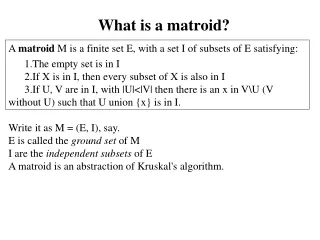
This lecture explores the concept of matroids and independent systems, defining these structures through finite sets and collections of subsets. We delve into hereditary properties and the role of independent sets. Key topics include different types of matroids, the definition and implications of maximal independent sets, and proofs of fundamental theorems such as the Greedy Algorithm for optimization problems. We also discuss practical applications like task scheduling and analyze the relationships between matroids and greedy algorithms, enhancing our understanding of mathematical structures in combinatorial optimization.

E N D
Independent System • Consider a finite set S and a collection C of subsets of S. (S,C) is called an independent system if i.e., it is hereditary. Each subset in C is called an independent set.
Maximal Independent Set Theorem
About Matriod Theorem An independent system (S,C)is a matroid iff for any cost function c( ), the greedy algorithm MAX gives a maximum solution. Proof. (=>) Next, we show (<=).
Unit-time Task Scheduling Input Output
Independence Lemma Proof.
Matroid Theorem Proof
What we learnt in this lecture? • What is matroid?. • matric matroid and graphic matroid. • Relationship between matroid and greedy algorithm.