Understanding the Fundamental Theorem of Calculus and Definite Integrals
The Fundamental Theorem of Calculus establishes a crucial connection between differentiation and integration. This section discusses the conditions under which a continuous function ( f ) on the interval ([a, b]) has an antiderivative ( F ) and offers insights into evaluating definite integrals. By recognizing that ( F ) can be used to determine the net signed area between the function graph and the ( x )-axis, this theorem simplifies the process of calculating integrals. Examples and practice problems enhance comprehension and application of these concepts.


Understanding the Fundamental Theorem of Calculus and Definite Integrals
E N D
Presentation Transcript
The Definite Integral Section 6.6
Fundamental Theorem of Calculus If f is continuous on [a,b] and F is any anti-derivative of f on [a,b], then
Fundamental Theorem of Calculus If f is continuous on [a,b] and F is any anti-derivative of f on [a,b], then
Fundamental Theorem of Calculus If f is continuous on [a,b] and F is any anti-derivative of f on [a,b], then
Examples • Evaluate • Evaluate
More Examples 3) Evaluate 4) Evaluate
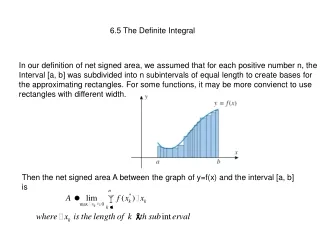
The Definite Integral If a function f is continuous on an interval [a,b], then f is integrable on [a,b], and the net signed area A between the graph of f and the interval [a,b] is This is called the definite integral of f from a to b. The numbers a and b are called the lower limit of integration and the upper limit of integration, respectively.