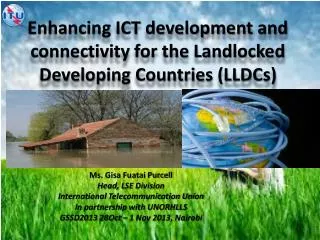
Enhancing ICT development and connectivity for the Landlocked Developing Countries (LLDCs)
220 likes | 356 Vues
This presentation explores the critical role of Information and Communication Technologies (ICT) in promoting development and connectivity in Landlocked Developing Countries (LLDCs). Presented by Ms. Gisa Fuatai Purcell of the International Telecommunication Union, it addresses challenges faced by LLDCs in accessing ICT infrastructure, highlights the importance of inclusive policies, and emphasizes the integration of ICTs in disaster management and climate change preparedness. The International Telecommunication Union's collaboration with UN agencies to support infrastructure development and regulatory frameworks is also detailed.


Enhancing ICT development and connectivity for the Landlocked Developing Countries (LLDCs)
E N D
Presentation Transcript
Enhancing ICT development and connectivity for the Landlocked Developing Countries (LLDCs) Ms. Gisa Fuatai Purcell Head, LSE Division International Telecommunication Union In partnership with UNORHLLS GSSD2013 28Oct – 1 Nov 2013, Nairobi
Order of Presentation • Brief on Information and Communication Technologies (ICTs) • Land locked countries • Challenges • ICT Development in LLDC • Policies, regulations, legislation • ICTs and Climate Change • ITU and Almaty PoA
ICTs Information and Communication Technologies (ICT). • refers to technologies that provide access to information through telecommunication networks • Fibre optic, submarine cables, satellite etc. • focuses on communication technologies delivering not only voice but data including multimedia. • include but not limited to: • i. the Internet – e-applications • ii. Infrastructure - mobile network, VSAT, BGAN • iii. The People Factor – inclusive including disability • Iv. Must be affordable, secure and
COMMON ICT SERVICES: • society enjoy a vast array of new communication capabilities. • people communicate and do business in real-time with others anywhere in the world 24/7 • instant messaging(viber) voice over IP (VoIP), and video-conferencing • social networking – Facebook, Twitter etc. allow users to communicate on a regular basis. • Saving Lives • early warning systems • Coordination of relief efforts during disasters
ROLE OF ICTS IN CLIMATE CHANGE PREPAREDNESS Vital role – Governments develop disaster management policies, regulation, and legal frameworks development. Implementation of ICT projects and capacity building activities for all COMMUNICATION MITIGATION Early Warning Systems, Establish Evacuation Centers – Advise people. Radio, Mobile Communication with people affected is critical. Radio, Television, mobiles – Internet.
ROLE OF ICT IN EMERGENCIES • Reports of a disaster to governments/partners from anywhere in the country • Photos and videos from anywhere in the country to relief organizations • Coordinate assistance and relief work • More importantly; Communicating with people affected.
But what is the cost of ICTs? • Recent studies – cost of ICTs are too expensive in developing countries • Bandwidth for one person in Korea may be the total bandwidth available in one developing country • Satellite costs – very high; unaffordable but most useful during disasters • Submarine cables and fibre optics – even higher in developing countries
What is the contribution of ITU in implementing the Almaty Plan of Action?
ITU ACTIVITIES FOR ALMATY PoA PRIORITY AREAS ACTIVITIES FUNDAMENTAL TRANSIT POLICY ISSUES • ICT Global Policy and Regulatory Framework Harmonization • Human and Institutional Capacity Bulding INFRASTRUCTURE DEVELOPMENT AND MAINTENANCE • Infrastructure Development Projects • Introduction of Sustainable Business Models • National Broadband Plans and Strategies INTERNATIONAL TRADE AND TRADE FACILITATION • E-Business, e-Government, e-Banking, e-Trading, PKI for Secure Transactions, Cybersecurity INTERNATIONAL SUPPORT MEASURES • Facilitating Access to technologies and transfer of know how. • Forging Partnerships (Gvts, IGOs, Industry) IMPLEMENTATION AND REVIEW • Concentrated Assistance, reporting.
The ITU Works in Partnership • UN agency for ICTs • Members: • 193 Member States (Governments and regulatory bodies) 700 Private Sector (Sector Members and Associates) 63 Academia • ITU works collaborattely with other UN agencies • Takes part in other UN agencies conferences • Provides input into UNGA various reports • Partnership with member states and private sector, civil society, academia • Play its role on developing telecommunications and ICTs for all Mr. Ban Ki-moon, Secretary-General of the United Nations and Dr. H. Touré, Secretary-General of ITU
ICTs also Save Lives in LLDCs Thank you