Download

1 / 7
70 likes | 195 Vues
The G.I.E.C. Space Probe Mission aims to explore Jupiter's four main moons—Ganymede, Io, Europa, and Callisto—in search of water and potential signs of life. Scientists believe that where there is water, there is a chance for life, making the discovery of water on these celestial bodies crucial for future colonization. The mission includes a rocket capable of deploying four autonomous probes, each equipped with drills and advanced imaging technology to analyze the moons' surfaces and subsurfaces. Launch is planned within the next 10-15 years, followed by a six-month journey to Jupiter.

E N D
The G.I.E.C. Space ProbeGanymede, Io, Europa, and Callisto By Jason Hunyar http://natsci.parkland.edu/ast/101/klinger/astronomy/solar%20system/ganymede.gif
Purpose of the Mission • Scientists believe there could be water on Jupiter’s main moons. • Scientist know that when there is water, there is a high chance of possible life. • The importance of finding water in other bodies is that we might be able to colonize on them. http://starchild.gsfc.nasa.gov/Images/StarChild/solar_system_level2/io_big.gif
Mission Description • It is a rocket capable of deploying four probes onto most planets or bodies. • The probes are each able to be operated from Earth, and they will constantly report back important information. http://www.ultimateuniverse.net/images/europa.jpg
Best Location • The most valuable place to send these probes would be to the four main moons of Jupiter. • They can land on the surface of the moons, no matter what terrain. • The probes would be on the poles of the moons, the most likely place for water to be found. • The main rocket would be in orbit around these moons, staying at each one for about two weeks, providing an overhead view.
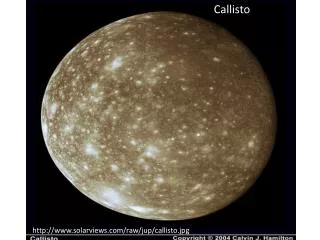
How Soon • The earliest the rocket could be launched is in 10-15 years. • The trip to Jupiter takes around 6 months, and then the probes would deploy and take about a week to get to the moons. • The probes are designed to send back information as soon as they land. http://cosmicdiary.org/blogs/nasa/david_smith/wp-content/uploads/2009/01/callisto.jpg
Instrumentation • The main probe (the one that deployed the four smaller ones), is equipped with a high-tech infrared and ultraviolet camera, so it could see in other wavelengths, through possible ice. • Each of the small probes would be equipped with a drill. The drill would have a camera on its tip so that we could see everything that the drill is passing through. • The drill would suck up anything it finds, and other analyzing equipment will process and store the samples.
Conclusion • The main mission of the G.I.E.C. Space Probe is to have four separate chances to find water so that we, humans, might be able to find places for future colonization.