Understanding Infinite Sequences and Series: Formulas and Sums
In this activity, you will master explicit formulas for arithmetic and geometric sequences, interpret limits of infinite sequences, and calculate the sum of terms in an infinite geometric series where the common ratio is between -1 and 1. You will also compare sequences that approach limits versus those that do not. By designing examples and solving exercises, you will enhance your understanding of infinite series and their properties. Prepare to explore both theoretical concepts and practical applications in your assignments.

Understanding Infinite Sequences and Series: Formulas and Sums
E N D
Presentation Transcript
Module 10 Activity 4 (Infinite Sequence) Objective: 1.After completing activity 4, mod. 10 2. With 90% accuracy 3. Write explicit formulas for arithmetic and geometric sequences Interpret the limit of an infinite sequence Determine the sum of the terms of an infinite geometric sequence in which the common ratio r is between –1 and 1 Compare sequences that do and do not approach limits
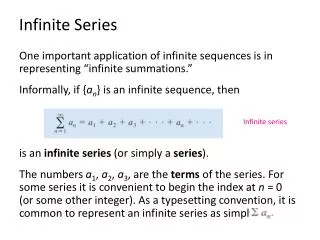
Infinite Series: • Every term in the sequence has a successor. Infinite sequences do not have a finite number of terms, but continue indefinitely.
11.3 Infinite Geometric Series • If a1, a2, a3, … is a geometric sequence and the sequence of sums S1, S2, S3, …is a convergentsequence, converging to a number S. • Then S is said to be the sum of the infinite geometric series
An Infinite Geometric Series : Given the infinite geometric sequence the sequence of sums is S1 = 2, S2 = 3, S3 = 3.5, … The calculator screen shows more sums, approaching a value of 4. So
Infinite Geometric Series Sum of the Terms of an Infinite Geometric Sequence The sum of the terms of an infinite geometric sequence with first term a1 and common ratio r, where –1 < r < 1 is given by .
Try this: • Consider the infinite geometric series below: • 27+9+3+1+… • Use the formula to find the sum of the infinite series. • 40.5 (this is considered the limit) • **Remember, if the series is infinite, it will never exactly reach 40.5, but it will approach it.
Notes: • The figure below shows the first 50 terms of a sequence. The sequence is approaching a limit. • What do you think the limit is? • 8
Your assignment: • Page 294 -295 warm up #1-4 • Page 296 Assignment #4.4, 4.5, 4.6, 4.8