Download
1 / 12
120 likes | 256 Vues
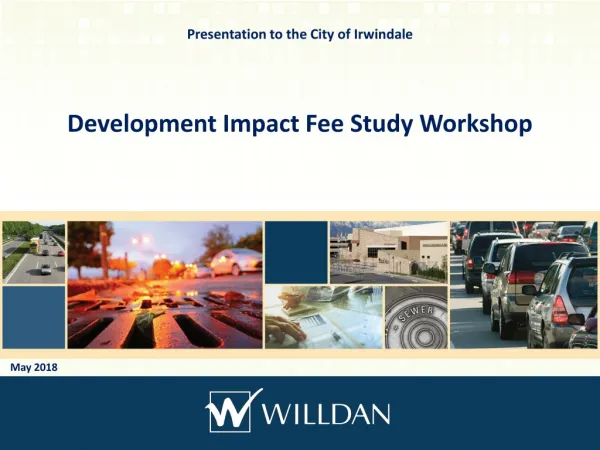
This workshop focused on impact fees charged to new developments in Irwindale, explaining their purpose and methodology. Impact fees are one-time charges collected at the time of building permits, targeted at covering the costs of new facilities needed for growth. The session discussed essential findings from the Impact Fee Nexus Study, emphasizing the proportionality between fees and facility costs, as well as the allocation of costs for new facilities. Key categories of impact fees were reviewed, including facilities for administration, libraries, parks, police, transportation, and wastewater.

E N D
Presentation to the City of Irwindale Development Impact Fee Study Workshop May 2018
What are impact fees? • One-time fees charged to new development, usually at building permit • Not an ongoing fee charged to residents or business owners • May be used to fund facilities needed to serve new development • Not for operations and maintenance costs • Not for the share of facilities serving existing development
Mitigation Fee Act Findings(Govt. Code §66001) • Key findings • Need: Development Need for facilities • Benefit: Development Use of revenue • Rough proportionality: Fee amount development’s share of facility costs • Other findings • Purpose of fee • Use of fee revenue
Impact Fees – Basic Methodology • Estimate existing development and future growth • Identify facility standards • Determine new facility needs and costs • Allocate share to accommodate growth • Identify alternative funding needs • Calculate fee by allocating costs per unit of new development
Allocating Cost of New Facilities:Existing Inventory vs. System Plan System Plan Method (Increase Service Level) 150 140 Existing InventoryMethod Growth Share 130 120 New Facilities 110 100 100 Fee $ 90 Fee $ Future Demand New Facilities 90 Future Demand 80 Existing Deficiency 80 70 70 60 60 50 50 Non-fee $ 40 40 Existing Demand Existing Facilities Existing Demand Existing Facilities 30 30 20 20 10 10 0 0 Facility Demand Facility Needs Facility Needs Facility Demand
Allocating Cost of New Facilities:Planned Facilities Method Planned Facilities Method • Use engineering models to demonstrate need for facilities to serve growth • Usually applicable for traffic & utility fees • May also have deficiencies that must be funded by alternative revenues 150 140 130 120 110 100 New Facilities 90 80 70 60 Fee $ Future Demand 50 40 30 20 10 0 Demand Facility Needs
Facility Standards and Cost Allocation EXISTING INVENTORY Existing Facilities Existing Service Pop. PLANNED FACILITIES Planned Facilities New Service Pop. SYSTEM PLAN Existing + Planned Facilities Existing + New Service Pop.
Irwindale Impact Fee Categories • Administrative Facilities • Libraries • Police Facilities • Parks and Recreation Facilities • Transportation Facilities • Storm Drain Facilities • Wastewater Facilities
Major Planned Facilities • General Government Facilities • City Hall Expansion • Library Expansion • Public Safety Facilities • New Police Station and Emergency Operations Center • Traffic/Transportation Facilities • Major Intersection Improvements • Infrastructure Facilities • Live Oak Ave/Arrow Highway Storm Drain Improvements • Live Oak Ave/Arrow Highway Sewer Improvements