Advances in Data Assimilation and Analysis for Geosciences: Enhancing Climate Prediction Models
This document discusses the latest methods, models, and algorithms applicable to geosciences, focusing on their integration into cyberinfrastructure supporting the NSF research community. It highlights advancements in numerical methods, data assimilation, and analytics, particularly through the Data Assimilation Research Testbed (DART), which enhances ocean modeling capabilities for improved climate forecasts. The emphasis is on uncertainty quantification, prototype development for coupled Earth system models, and the utility of observational datasets in refining predictive capabilities, ultimately aiding in climate change assessments.

Advances in Data Assimilation and Analysis for Geosciences: Enhancing Climate Prediction Models
E N D
Presentation Transcript
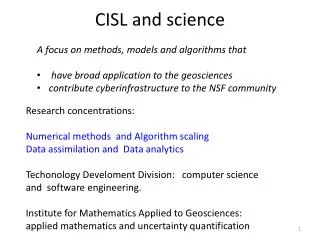
A focus on methods, models and algorithms that • have broad application to the geosciences • contribute cyberinfrastructure to the NSF community CISL and science Research concentrations: Numerical methods and Algorithm scaling Data assimilation and Data analytics TechonologyDeveloment Division: computer science and software engineering. Institute for Mathematics Applied to Geosciences: applied mathematics and uncertainty quantification
Data Assimilation Data Assimilation: combining observations with a numerical model to produce an improved forecast or prediction. Science highlight: Assimilation for the Community Earth System Model Community Connections: Data Assimilation Research Testbed (DART)
Develop assimilation capability for the ocean model component (POP) of CESM • Pressing need for initial fields for IPCC decadal climate predictions. • Will aid in model calibration and development. • Prototype for fully coupled earth system model assimilation. • Ensembles allow for uncertainty quantification.
World Ocean Database T,S observation counts These counts are for 1998 & 1999 and are representative. FLOAT_SALINITY 68200 FLOAT_TEMPERATURE 395032 DRIFTER_TEMPERATURE 33963 MOORING_SALINITY 27476 MOORING_TEMPERATURE 623967 BOTTLE_SALINITY 79855 BOTTLE_TEMPERATURE 81488 CTD_SALINITY 328812 CTD_TEMPERATURE 368715 STD_SALINITY 674 STD_TEMPERATURE 677 XCTD_SALINITY 3328 XCTD_TEMPERATURE 5790 MBT_TEMPERATURE 58206 XBT_TEMPERATURE 1093330 APB_TEMPERATURE 580111 • temperature observation error standard deviation == 0.5 K. • salinity observation error standard deviation == 0.5 msu. AMS New Orleans 2012
Physical Space: 1998/1999 SST Anomaly from HadOI-SST • POP forced by observed atmosphere (hindcast) Coupled Free Run POP forced by hindcast DART Assimilations 23 POPs / 1 CAM 48 POPs / 48 CAM
DART is used at: 43 UCAR member universities More than 100 other sites • Public domain software for Data Assimilation • Well-tested, portable, extensible, free! • Models • Toy Examples • Global (7) , Regional (5), Chemistry (2), Ocean (4), Upper atm. (3), and CLM. • Observations • Real, synthetic, novel • An extensive Tutorial in MATLAB • With examples, exercises, explanations DART is cited in 15 CESM talks and 12 posters at June Breckenridge meeting
Data Analytics Data Analytics:The discovery and communication of meaningful patterns in data. Science Highlight: Western US precipitation extremes in regional models and observations • Community Connections: • Extremes Toolkit • NSF Math Institutes
Daily Precipitation for the Western US How well does a regional climate model simulate extremes? Gridded Daily Obs WRF / NCEP • Maximum of Daily precipitation in 200 km footprint over study region • Found for 1981 -1999. • Regional climate model runs a small subset of NARCCAP
Analysis of dependence between extremes Frechet scale Original Scale (mm) Observed Daily Max Frechet Observed WRF Daily Max Frechet WRF • Correlations on original scale are not appropriate. • Analysis on Frechetscale, appropriate for extremes, • indicates a significant dependence. • some extremes associated with Pineapple Express.
Connections to community • Training: Extremes project CSU PhD student (Grant Weller); faculty advisor a former CISL post doc (Dan Cooley). • On average 3 statistics post docs/year in CISL has linked NCAR to the statistics research community. • Visitors • NCAR node in NSF Math/Climate Research Networks: • Statistics Methods for Atmosphere and Ocean sciences • Mathematics and Climate Research Network • NSF Math Institutes • SAMSI, MSRI, IMA, BIRS
Conclusions • Many other highlights in numerics, multi-scale modeling, regional climate, … • Visitors • Theme-of-the-year ??? • Training.
Extremes toolkit in R Filled the need for introducing modern statistical analysis of extremal data to the climate community Interactive analysis for the tail of a distribution using extreme value theory > 700 registrations Uses the R Statistical Environment, a community based and open source activity