Understanding Polynomials: Definitions, Like Terms, and the FOIL Method
This guide provides a comprehensive overview of polynomials, including definitions of key terms such as degree and like terms. A polynomial is described as an expression made of constants, variables, and exponents combined through addition, subtraction, and multiplication (not division). Learn how to identify like terms, add them by combining coefficients, and apply the FOIL method for multiplying polynomials. Practical examples illustrate how to execute these operations, helping you master polynomial concepts for homework and exams.

Understanding Polynomials: Definitions, Like Terms, and the FOIL Method
E N D
Presentation Transcript
5.2 Polynomials Like terms FOIL method
Definition of a Poly Poly- \Pol"y-\ [See Full, a.]A combining form or prefix from Gr. poly`s, many; as, polygon, a figure of many angles; polyatomic, having many atoms; polychord, polyconic. [1913 Webster] Also, polymorphic, polyester, polyamorous.
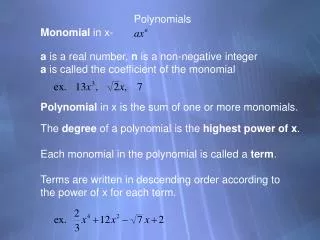
Definition of a Polynomial A polynomial is an expression made with many constants, variables and exponents, which are combined using addition, subtraction and multiplication, ... but not division.
Degree of a polynomial In a polynomial you find the terms with the highest exponent or addition of exponents; these would be the degree of the polynomial.
Like Terms Terms that are fond of each other Terms with the same variable and exponent. 5x4y3 8x4y3 What can you do with like terms?
Adding Like terms When you add like terms, you add their coefficients. 5x4y3 + 8x4y3 = (5 + 8)x4y3 = 13x4y3 You do not add the exponents. Why?
Adding and Subtracting polynomials Add Remove the parentheses by distributing the number in front. In this case it is a one. Then add the like terms
Multiply Polynomials We use the distributive property to multiply a monomial times binomial, trinomial or any polynomial.
Multiplying a binomial by a binomials Here we double distributive or more often call FOIL
Multiply using FOIL (x – 5)(x + 2) x2 + 2x – 5x – 10 x2 -3x - 10
Multiply using FOIL (x – 5)(x + 2) x2 + 2x – 5x – 10 x2 -3x - 10
Multiply (x + 3)(x2 – 5x + 10)
Multiply (x + 3)(x2 – 5x + 10) x3 – 5x2 + 10x
Multiply (x + 3)(x2 – 5x + 10) x3 – 5x2 + 10x + 3x2 – 15x + 30
Multiply (x + 3)(x2 – 5x + 10) x3 – 5x2 + 10x + 3x2 – 15x + 30 x3 -2x2 – 5x + 30
Homework Page 231 – 232 # 17 – 33 odd, # 37 – 45 odd
Homework Page 231 – 232 # 22 – 32 even, # 38 – 50 even